
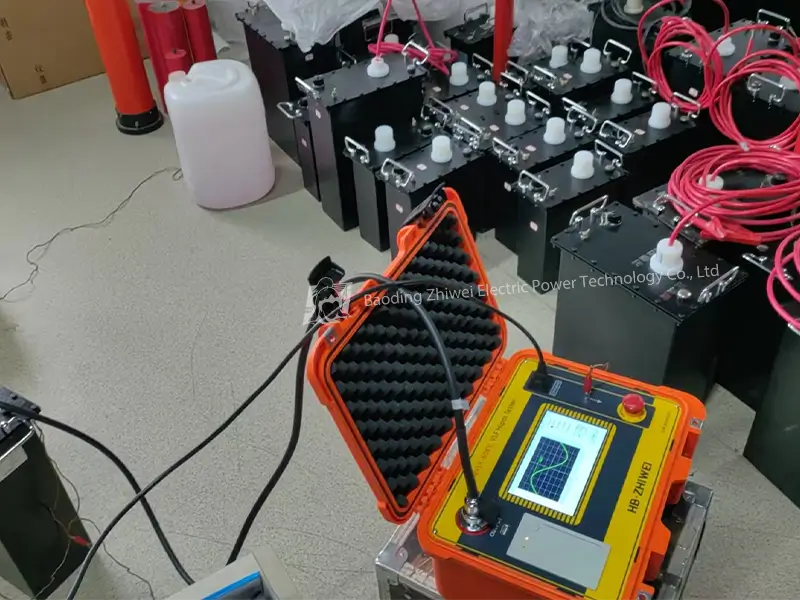
In routine high-voltage substation commissioning and power system maintenance, on-site hipot testing of newly laid medium and high-voltage power cables has long been a major headache for insulation engineers.
Traditional power-frequency AC hipot testing equipment is extremely bulky. It often weighs several tons and requires heavy-duty trucks for transport, making it nearly impossible to deploy in cramped and complex substations. Meanwhile, although traditional DC hipot testing is portable, it has been scientifically proven to potentially damage widely used new extruded insulation cables like cross-linked polyethylene (XLPE).
How do we solve this dilemma? The answer is: VLF AC Hipot Testing Technology.
As a modern, safe, highly portable alternative that fully complies with international standards, VLF technology has become the globally recognized benchmark for high-voltage cable insulation diagnostics. In this in-depth guide, we will break down exactly what VLF testing is, the underlying physics behind its high efficiency, and why every modern maintenance team needs this technology.
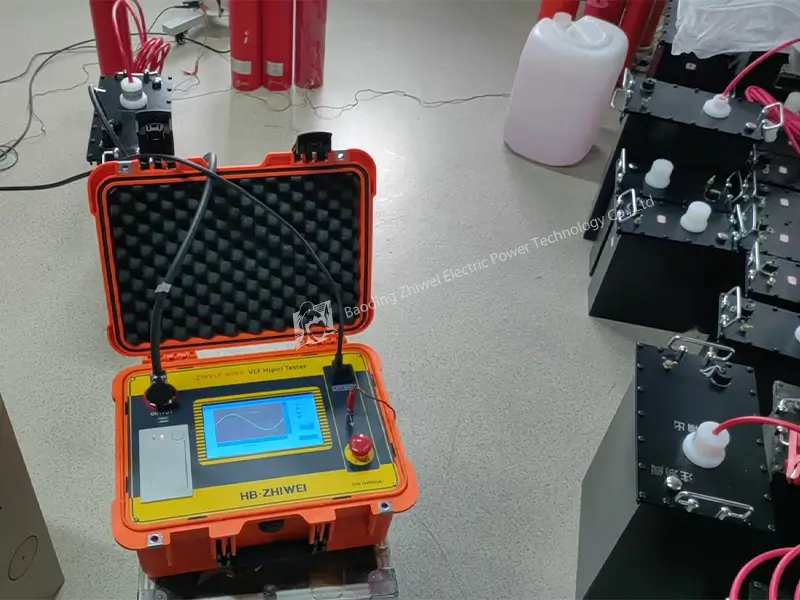
What is VLF Testing?
VLF stands for Very Low Frequency. In the power testing industry, VLF testing generally refers to an AC hipot test where the instrument’s AC high voltage output frequency is fixed at 0.1 Hz (or lower).
To understand why switching from a 50Hz/60Hz power frequency to a 0.1Hz very low frequency is a revolution, we have to look at the underlying physics formulas.
A long-distance high-voltage cable laid underground essentially acts as a giant capacitor because it has a conductive core and a shield layer, separated by a middle insulation layer.
When using an AC hipot test to charge this large capacitor and maintain a specific test voltage (U), the charging current (I) required by the test instrument can be accurately calculated using the following electrical formula:
I = 2πf · C · U
Note: I is the test output current, f is the test frequency, C is the equivalent capacitance of the tested cable, and U is the applied peak test voltage.
According to this physical formula, provided the test voltage (U) and the cable’s own insulation capacitance (C) remain constant, the current (I) the instrument needs to output is directly proportional to the applied frequency (f)!
When you drastically drop the test frequency from a standard 60Hz to 0.1Hz, the frequency is reduced by 600 times. This means that to build up the exact same tens of kilovolts of test voltage across that massive cable capacitance, the output current and total power (kVA capacity limit) required from your testing equipment are also drastically reduced by 600 times!
Thanks to this brilliant physical principle, the traditional power-frequency test terminal—which used to rely on transformer oil for cooling and weighed several tons—has evolved into a smart VLF hipot tester. Now, it’s roughly the size of a suitcase, weighs less than 50 kg, and can be easily hand-carried by a single field technician deep into the mountains or down a cable trench.
What High-Voltage Equipment Can VLF Test?
Because a VLF hipot tester can steadily drive massive capacitive loads using an exceptionally small power capacity, it is widely used to evaluate the insulation of various critical power assets:
Low, Medium, and High-Voltage Power Cables: It is the premier tool globally for handover and preventive testing of solid extruded insulation cables like XLPE (cross-linked polyethylene) and EPR (ethylene propylene rubber), especially for the 10kV to 35kV voltage ratings.
Large Rotating Machinery: It is commonly used for overall insulation hipot and dielectric loss testing of stator windings in hydroelectric plants, steam turbine generators, and large heavy-industry motors.
High-Voltage Switchgear and Compensation Capacitors: It is widely used for routine insulation checks on high-voltage switchgear and large shunt compensation capacitor banks in substations.
When is VLF Hipot Testing Required?
To protect power grids and industrial facilities from sudden outages, experienced maintenance managers typically introduce VLF testing at three crucial stages of an asset’s life cycle:
Handover/Acceptance Testing: Performed after new cables are fully laid on-site and the terminations and splices are completed, but before they are officially energized. The goal is to verify with 100% certainty that the installation team hasn’t caused any mechanical pulling damage and to check for any severe defects in the splicing workmanship.
Routine Preventive Maintenance: This acts as a regular “health checkup” for aging cable systems that have been running for years or decades, helping accurately catch and replace minor hidden flaws before they evolve into catastrophic short-circuit discharges or explosions.
Post-Repair Diagnostics: After a cable short-circuit accident occurs and a new intermediate splice is repaired, this test immediately verifies if the new splice can withstand the main grid’s power supply requirements, ensuring a safe power restoration.
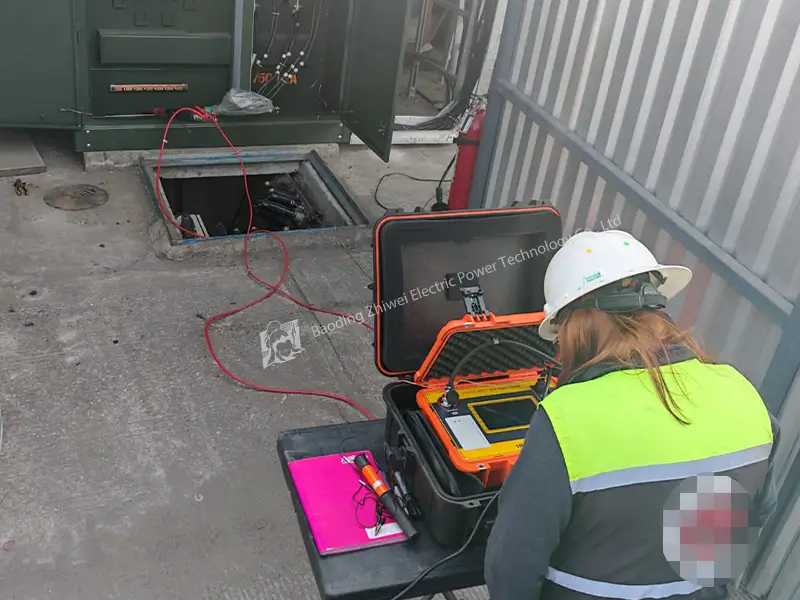
Core Comparison: Why Must VLF Replace Traditional DC Hipot Testing?
Over the past few decades, traditional high-voltage Direct Current (DC) testing was commonly used to evaluate legacy power cables. However, with the widespread use of modern XLPE cross-linked cables today, global authoritative standards have completely rejected and strongly prohibit the continued use of DC hipot testing on these medium and high-voltage extruded cables.
Here are the fundamental technical reasons why the shift from DC to VLF is irreversible:
The Fatal Flaw of DC Testing: Space Charge Accumulation
When you continuously inject high-voltage DC into a perfectly insulated XLPE cable, the intense unidirectional electrostatic field causes what is known as “space charge accumulation” within the microscopic voids of the dielectric layer. Even after the test concludes and the cable is fully discharged, these invisible “charge traps” remain stubbornly locked inside the insulation.
When the cable is later reconnected to the standard AC main grid, the alternating power-frequency AC voltage inevitably superimposes forcefully onto the pre-existing space charge field. This induces an incredibly strong, concentrated localized electric field that can directly punch through sections within the insulation, rapidly triggering fatal “water treeing or electrical treeing.” As a result, a perfectly healthy cable insulation might not only fail to be properly tested but could actually suffer premature, irreversible explosive breakdown and severe damage just days or weeks later!
The Non-Destructive Advantage of VLF AC Testing
As a radical improvement, VLF is fundamentally standard alternating AC current. It completes a full positive and negative alternating cycle every 10 seconds (0.1Hz, meaning the positive and negative poles each last for 5 seconds). This guarantees that fatal unidirectional static space charges absolutely do not accumulate inside the insulation!
For completely healthy and intact insulation, VLF testing is a purely non-destructive diagnosis. On the other hand, for severe hidden defects where internal treeing or air gap damage has already occurred, the test uses ultra-low AC stress to intentionally and safely trigger a controlled breakdown right from the test console, exposing the fault in advance.
This highly safe and robust characteristic makes VLF the core cable acceptance method unanimously highly recommended and explicitly advised by top-tier international technical standards like IEEE 400.2 and the International Electrotechnical Commission’s IEC 60060/IEC 60502.
Tech Insights: How to Accurately Select Frequencies and Understand Real Calibration Certificates
As a manufacturer with extensive R&D and practical field experience, Baoding Zhiwei Technology Co., Ltd. deeply understands that accurately mastering output frequency settings and equipment measurement precision on-site directly determines the testing success rate of your entire project.
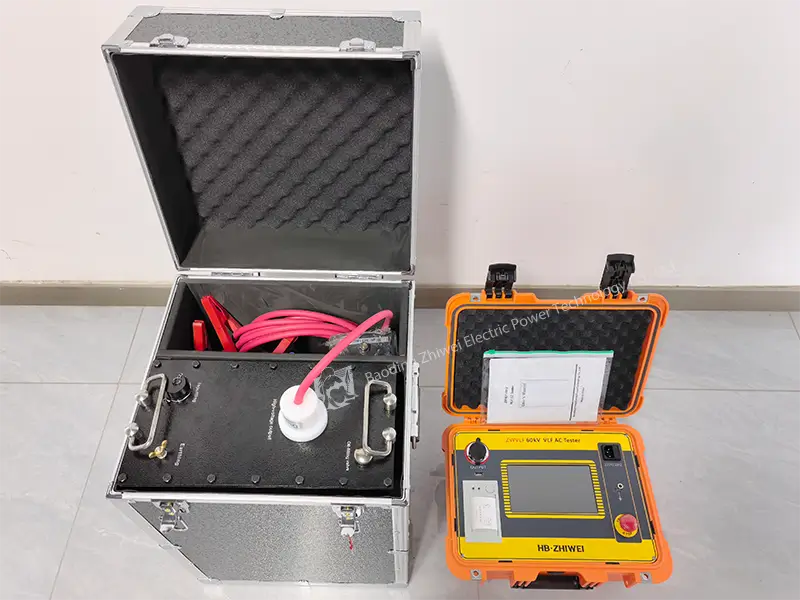
Cable Length Matching Guide for Graded Frequency Load Capacities
In our new generation of ZWVLF very low frequency hipot devices, we have equipped multiple variable frequency output options (0.1Hz, 0.05Hz, 0.02Hz, and 0.01Hz) to perfectly handle the varying capacitive load challenges posed by different cable lengths:
0.1Hz Output Range (drives up to 0.5 μF): Suitable for standard short-to-medium distance power cables with a single test length of around 1 to 1.5 km.
0.05Hz Output Range (drives up to 1.1 μF): Suitable for power transmission and distribution scenarios where routine cable lengths extend to 1.5 to 3 km.
0.02Hz Output Range (drives up to 2.2 μF): Specifically designed for medium-to-long cables reaching 3 to 6 km, such as cross-plant and main-line levels.
0.01Hz Output Range (drives up to 5.5 μF): Extreme payload capacity. It smoothly outputs sufficient peak high voltage without compromise, even when dealing with cross-regional or remote ultra-long cable sections of 6 to 9 km!
Real Lab-Grade Calibration Proof
Precision shouldn’t just be on paper. To demonstrate our equipment’s ultra-precise, instrument-grade linear performance, here is actual metrology calibration data from our latest internal state-regulated factory testing lab, verifying a ZWVLF-40KV VLF Hipot Tester (Factory Serial Number SN: 202607291, Actual Calibration Test Date: July 13, 2026):
Table 1: Insulation System Hipot Verification — Actual Output High Voltage Comparison Error Table (ZWVLF-40KV / SN: 202607291)
| National-Grade High-Precision Standard Reference Value | Actual Measured Output Reading of This Device | Real-Time Calculated Error Rate | Final Conclusion |
|---|---|---|---|
| Reference HV 10.0 kV | Real-Time Measurement 10.0 kV | 0.0% | PASS |
| Reference HV 20.0 kV | Real-Time Measurement 20.1 kV | +0.5% | PASS |
| Reference HV 30.0 kV | Real-Time Measurement 29.8 kV | -0.7% | PASS |
| Reference HV 40.0 kV | Real-Time Measurement 40.2 kV | +0.5% | PASS |
Note: Not only is the voltage controlled well within the extreme industrial benchmark of ±1%, but the positive and negative peak errors of the internal carrier wave are also strictly kept at ≤3%. Furthermore, the overall sine wave distortion rate is precisely suppressed to an ideally clean ≤5%! This guarantees that every single AC wave applied to your expensive cables is clean and completely controlled.
Frequently Asked Questions (FAQ)
Q1: Will a VLF test really directly break down and destroy an intact high-voltage cable?
Absolutely not. For healthy insulation media, VLF is a completely harmless, safe signal. If a breakdown occurs, it definitively proves that severe external damage, stripping defects, or end-stage dielectric aging air gaps were already lurking in the tested cable section. E
ven if these hidden dangers aren’t exposed during a VLF test today, they will inevitably trigger unannounced trips or even severe phase-to-phase arc fires on the main circuit a few weeks or months later. Exposing these faults early under a safely controlled test platform is precisely the greatest core value of a hipot test.
Q2: Can VLF testing be used to test older Paper Insulated Lead Covered (PILC) cables, just like XLPE?
Yes, absolutely, and it is highly recommended! Not only is VLF the universally recognized core standard for all classes of modern cross-linked cables (XLPE/EPR), but it has also long been safely used to test various legacy and mixed PILC cables. Unlike impulse or high-voltage DC, it won’t easily ignite or break down the older paper insulation oils.
Q3: How long is it generally recommended to continuously apply test voltage for a complete high-voltage power cable test?
According to the authoritative international IEEE 400.2 standard, the minimum continuous test duration for a standard VLF 0.1Hz hipot test should fall between 15 and 60 mins. The specific time can be adjusted based on the purpose of the test (for example, a preliminary 15-30 minute handover test for new cables in a new facility, or a strict 60-minute preventive diagnostic assessment required for older substations).
EXPERT GUIDANCE
Need Help Choosing the Right Testing Equipment?
Conclusion
In summary, driven by its underlying physical advantages, VLF hipot testing technology perfectly resolves two major pain points: the extreme bulkiness of traditional power-frequency equipment, and the risk of traditional DC tests damaging modern cable insulation.
It is not just a modern high-voltage insulation diagnostic benchmark fully compliant with IEEE 400.2 and IEC standards; it is also an indispensable safety tool for every modern grid maintenance team during handover acceptance, daily maintenance, and emergency fault repair. Choosing VLF means choosing to nip all hidden insulation crises in the bud, without ever harming your equipment.
Comprehensively Upgrade Your Cable Insulation Diagnostic Platform
If you want to dramatically improve your on-site testing efficiency, or if you are looking for a portable, precise, and rugged next-generation testing device, it’s time to experience the ZWVLF Very Low Frequency product series from Baoding Zhiwei Technology Co., Ltd.
[Click Here] to contact our expert technical team and get a free, complete technical selection guide for the ZWVLF Smart Variable Frequency Hipot Tester, as well as an exclusive, customized testing plan tailored to the specific cable lengths and voltage ratings of your substation or plant!
Or reach out to us directly via:
Email: sales001@zhiweielectric.com
Phone / WhatsApp: +86 13833237336