
Transformers are essential core assets in any power grid. Inside them, the insulating oil not only provides crucial electrical insulation but also cools down the internal heating parts. Over long periods of operation, the combined effects of heat, electrical stress, and environmental factors cause the insulating oil to undergo irreversible chemical degradation. During this deterioration stage, a rising acid value is one of the most obvious and destructive signs of aging.
Acid value is a core parameter for evaluating oil aging. More importantly, it serves as an “Early Warning Indicator” for the declining lifespan of the transformer’s internal insulation system. Once acidic byproducts build up in large quantities in the oil, they directly cause and speed up the breakdown of the transformer’s solid insulation materials (insulating paper).
To prevent Unplanned Downtime and extend the transformer’s life, we must deeply understand the Causes of Oil Oxidation. Using a high-precision Oil Acid Tester for regular condition monitoring is an absolutely essential Preventive Maintenance strategy for power engineers worldwide.
Table of Contents
I. Three Core Factors Behind Transformer Oil Oxidation
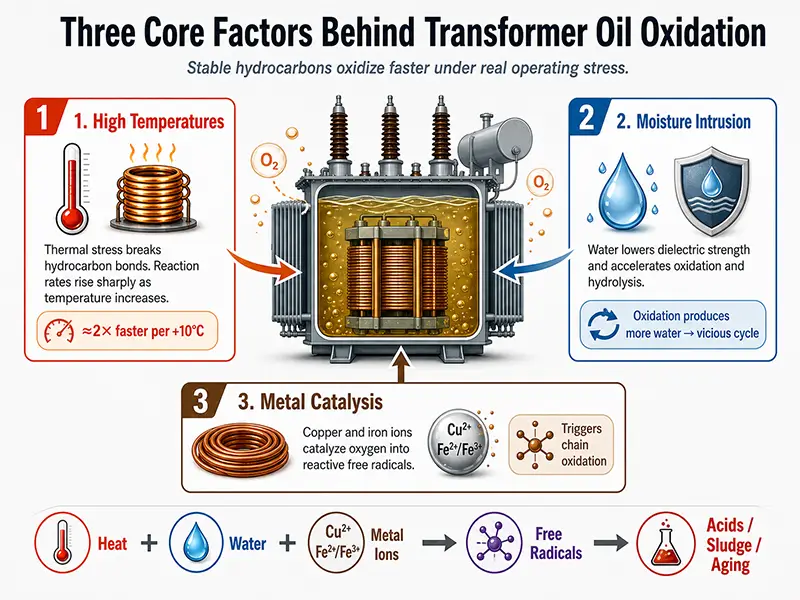
Transformer oil mainly consists of naphthenes, paraffins, and small amounts of aromatics. Under ideal conditions, these hydrocarbons are extremely stable. However, in complex real-world operations, the oil’s oxidation process is significantly sped up by the following three main factors:
1.1 High Temperatures (Thermal Stress)
When a transformer runs at full load or is overloaded, its coils and iron core generate a massive amount of heat. According to the Arrhenius equation, the chemical reaction rate roughly doubles for every 10 ℃ increase in temperature. Prolonged exposure to high temperatures breaks the chemical bonds of the hydrocarbons, making them much easier to react with any excess oxygen that enters the system.
1.2 Moisture Intrusion (The Vicious Cycle of Water)
Moisture is the natural enemy of insulation systems. Even tiny amounts of water (measured in ppm) will drastically reduce the dielectric strength. Water molecules also act as polar agents that participate in and speed up the oil’s oxidation and hydrolysis reactions. Making matters worse, the oxidation of the oil itself produces even more water, creating a deadly vicious cycle.
1.3 Metal Catalysis (Especially Bare Copper Cores)
Transformers contain large amounts of copper and iron. At normal operating temperatures, these metals—especially oxidized copper ions—act as highly active catalysts for oxidation. They help turn free oxygen molecules in the oil into highly reactive free radicals, triggering an uncontrollable chain oxidation reaction.
II. Chemical Mechanism: Free Radical Chain Reactions and the Irreversible Degradation of Insulating Paper
To better explain exactly how high acid values harm transformers, we need to look at the chemical process at a microscopic level. The oxidation of transformer oil is not a simple, single-step reaction. Instead, it is a complex and classic Free Radical Chain Reaction.
1. Step 1 (Chain Initiation): Under heat or metal catalysis, hydrocarbons (represented by R – H) break apart to form alkyl free radicals.
R − H → R · + H ·
2. Step 2 (Chain Propagation): These highly unstable radicals quickly bond with dissolved oxygen in the oil to form peroxy radicals. Through complex peroxide intermediates, they finally break down into various organic acids, such as low-molecular-weight formic and acetic acids, as well as high-molecular-weight naphthenic acids.
R · + O2 → R − O − O · → R − O − O − H → … → R − COOH
Why does a rising acid value drastically cut insulation life?
The main solid insulation material inside a transformer is insulating paper, which is made of large cellulose molecules. The chemical structure of cellulose, (C6H10O5)n, is highly sensitive to acids. Low-molecular-weight organic acids (R-COOH) produced in the insulating oil are very easily absorbed by the insulating paper.
These acids cause the 1,4-beta-glycosidic bonds in the cellulose chains to break down (a degradation reaction). This causes the paper’s degree of polymerization (DP value) to drop rapidly.
When the DP value falls from about 1000 in brand-new paper down to around 200, the insulation paper becomes as brittle as dry leaves and loses its mechanical strength. If the power grid experiences a short circuit shock, this fragile paper will easily break apart, directly leading to phase-to-phase short circuits or even explosive losses.
III. Monitoring Solutions: From Traditional Manual Titration to Fully Automatic Precise Titration
Traditional manual titration methods rely on the operator’s naked eye to spot color changes in indicators. This approach is highly prone to human error and forces operators to frequently handle toxic chemical extraction agents. To detect tiny fluctuations in acid values, modern power laboratories need digital analysis methods that are far more precise, safe, and efficient.
Today, using the ZWYG-3 Fully Automatic Extraction Oil Acid Tester is widely recognized across the industry as a mature monitoring solution. It powerfully upgrades transformer maintenance from “error-prone manual sampling estimations” to “lab-grade, high-precision automatic measurement”:
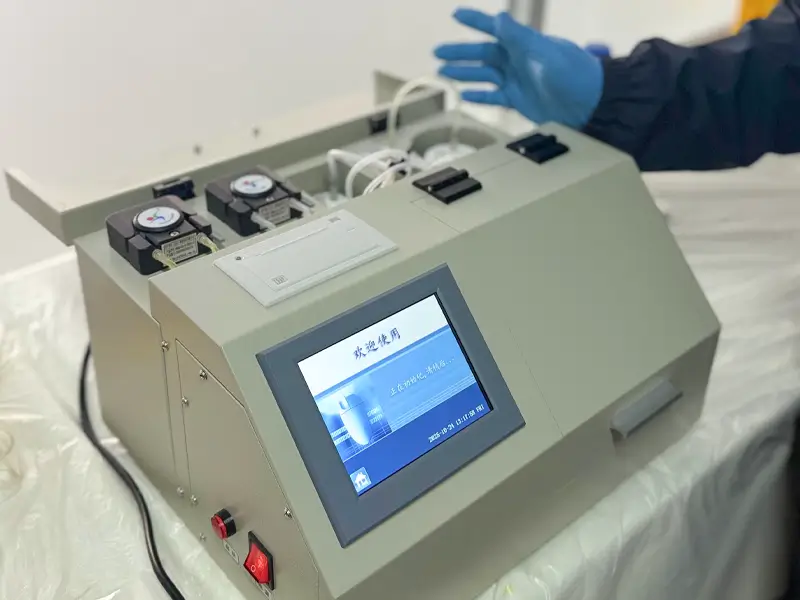
- Fully Automatic 3-Cup Continuous Testing (Extreme Efficiency): The instrument features a unique 3-cup extraction design. Operators just need to place the oil samples on the sample tray, and the machine automatically completes the full cycle: sample extraction -> extractant injection -> mixture extraction -> neutralization titration -> data printing -> automatic pipe cleaning. By starting one measurement, it continuously tests 3 samples, completely eliminating cross-contamination from manual handling steps.
- Adaptive Background Subtraction (Ultimate Precision): Because extraction liquids can easily develop a slight background acidity due to environmental effects, the instrument automatically runs a “blank titration” before each test. It calculates and subtracts the background deviation in real-time, keeping measurement repeatability within an outstanding range of ≤±0.005mg KOH/g.
- One-Click Automatic Standard Acid Calibration: The neutralizing fluid (ethanol-KOH solution) easily absorbs CO2 from the air, which can lower its effective calibration concentration. Built with a calibration program using an aqueous potassium hydrogen phthalate standard acid, users can quickly verify the titration system with one click, ensuring data remains reliable over long testing cycles.
IV. Global Proof: ZWYG-3 Successfully Passes Calibration Verification by Southeast Asian VILAS Certification Body
In real-world industrial settings, the precision and reliability of an instrument must survive testing by authoritative third-party calibration standards. Recently, our ZWYG-3 Fully Automatic Oil Acid Tester was officially delivered to a major national power service and engineering technology company in Southeast Asia. To ensure power grid safety, this client manages a huge volume of daily insulating oil tests for local ultra-high voltage substations. They maintain extremely strict requirements on instrument accuracy.
1. Authoritative Third-Party Calibration Test
Before entering official commercial compliance testing, the client submitted the ZWYG-3 unit to a large, nationally accredited chemical analysis and environmental testing center (This lab holds international VILAS calibration accreditation and strictly follows the ISO/IEC 17025 international management system) for compliance calibration.

2. “Excellent Testing Performance” and Field Feedback
The detailed compliance calibration report confirmed that the ZWYG-3 passed all testing standards and achieved an outstanding rating in critical core parameters, including optoelectronic titration endpoint detection, high-frequency stepper pump dosing accuracy, and multi-sample data reproducibility.
The senior application engineer in charge of on-site commissioning reported:
“The calibration results show that the instrument is producing very good results. ”

At the same time, according to field operation feedback, the client has successfully integrated the ZWYG-3 Fully Automatic Oil Acid Tester with the ZWWS101C Karl Fischer Trace Moisture Tester they purchased concurrently. This golden pairing of “Acid Value + Trace Moisture” is now fully operational at this large power engineering facility, actively used to quickly diagnose the oil condition and aging status of high-voltage transformers, constructing a solid defense line for power safety.
(Note: To comply with NDAs and protect client assets, the displayed documents and brand identifiers are redacted. Unauthorized use is strictly prohibited.)
V. Recommended Testing Frequencies: Building a Preventive Maintenance System
To spot and stop problems before they arise, we recommend setting up scientific sampling and testing schedules based on the operating conditions of different transformers:
- New Oil / Commissioning After Overhaul: A baseline test must be conducted before filling the equipment. The acid value must be extremely low (usually ≤0.03mg KOH/g) to build a data record for future comparisons.
- 35kV and Below Routine Operation Transformers: We recommend testing the acid value at least once a year.
- 110kV – 220kV Large Transformers: We recommend conducting a comprehensive oil test every 6 months to closely monitor any upward trends in the acid value.
- 500kV and Above Ultra-High Voltage Transformers: The safety margin for insulation is very slim. We recommend taking precise samples every 3 to 6 months, combined with DGA (Dissolved Gas Analysis) for comprehensive physical judgments.
EXPERT GUIDANCE
Need Help Choosing the Right Testing Equipment?
VI. Frequently Asked Questions (FAQ)
1. The lab report shows a sudden spike in the oil acid value. Do I need to shut down the machine immediately?
You do not necessarily need to shut it down right away, but you must trigger a high-level warning alert. If the detected acid value exceeds 0.1mg KOH/g (please refer to the specific standard for your voltage level), you should shorten the testing cycle to once a month. You should also schedule oil filtering to remove acid, or process oil regeneration.
Simultaneously, you should test the furfural content to determine if the internal insulating paper has already suffered irreversible chemical damage.
2. Can oil regeneration (Reclamation) completely fix the damage caused by high acid values?
Oil reclamation (such as using adsorbents like fuller’s earth) can completely remove existing free acids, polar sludge, and impurities from the oil, bringing the oil’s parameters back to normal levels. But please remember!
Insulating paper that has already suffered broken-chain aging (a drop in the degree of polymerization) cannot be restored. Regeneration can “purify the transformer’s blood,” but it cannot “reverse the aging of its organs.” Therefore, frequent and precise early acid value screening remains the only way to stop the early aging of insulating paper.
VII. Build an Electrochemical Protective Barrier for Your Power Transformers Today
Do not wait to take rescue measures only after a transformer breaks down due to brittle insulating paper. Accurate physical and chemical oil data acts as your first line of defense in keeping your power equipment assets completely safe.
Contact us today to get the detailed technical specifications and case study collection for the ZWYG-3 Fully Automatic Oil Acid Tester. Discover how utilizing advanced, fully automatic titration testing technology can safeguard the health and lifecycle of your transformers.