
In critical infrastructure like data centers, substations, communication base stations, and renewable energy storage systems, the DC power system (backup battery bank) acts as the “last line of defense” against power outages. However, industry maintenance data shows that over 80% of backup power failures are caused by hidden aging batteries that were not discovered in time.
Many facility managers fall into a common trap: believing batteries are healthy just because their daily “float voltage” reads normal. In reality, float voltage can be highly deceptive. The voltage might look perfect when the battery is idle, but the battery could instantly collapse when a real power outage occurs and it takes full load. To eliminate this hidden risk, regular battery discharge testing is the only and most authoritative diagnostic method.
This article will deeply explain the core principles of discharge testing, why it is necessary, and the selection guidelines for modern smart testing equipment.
What is True Battery Discharge Testing and Capacity Evaluation?
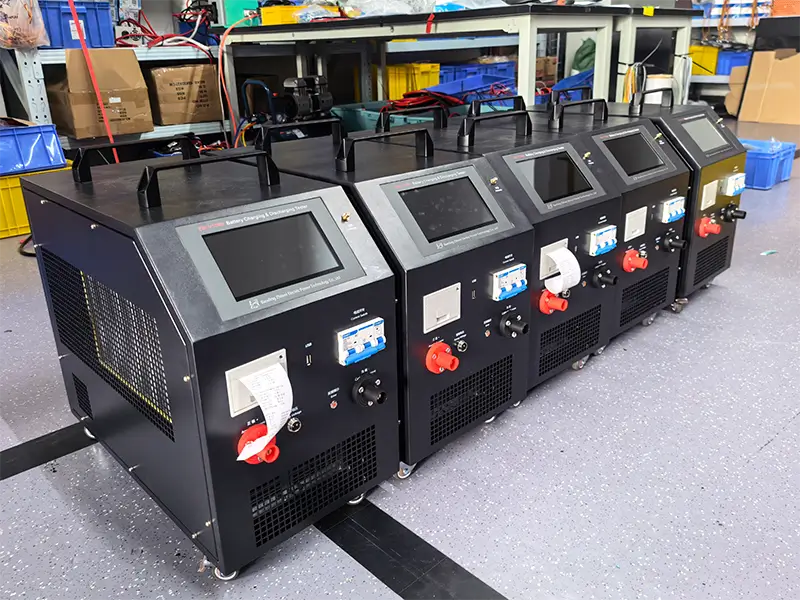
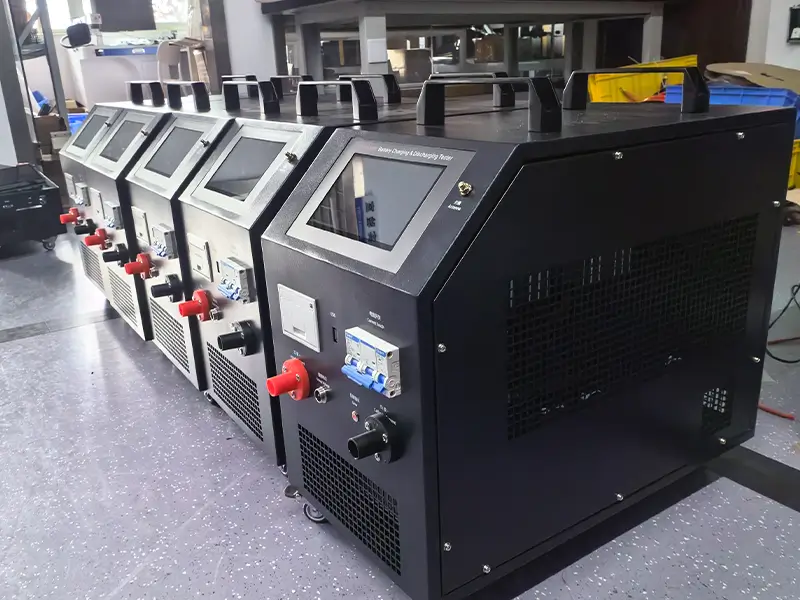
Battery discharge testing, also known as dummy load testing, involves connecting a dedicated electronic load device to discharge the battery bank continuously at a constant current or constant power until the battery voltage drops to a preset end-of-discharge voltage.
By accurately recording the discharge current and time, maintenance engineers can calculate the battery’s actual remaining capacity. The basic mathematical model is as follows:
C = I × t
Note: C is the battery capacity in Ampere-hours Ah; I is the constant discharge current in Amperes A; t is the discharge time in hours h
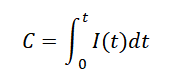
In addition, to simulate real backup times under load, modern high-end testing standards have introduced the Constant Power Discharge mode. In this mode, the system correctly calculates energy and capacity using integration formulas:
Why is an In-Depth Battery State of Health (SOH) Evaluation Crucial?
Following standard practices and international regulations for lead-acid battery maintenance to conduct regular verification discharge tests can bring the following core values to enterprises:
Reveal the true health status: Accurately identify deep physical and chemical defects like plate corrosion, internal sulfation, or electrolyte dry-out, which cannot be found just by measuring voltage.
Locate “lagging cells”: Battery banks follow the “wooden barrel effect” (the weakest link principle). By monitoring real-time cell voltage, you can accurately pick out the one or two bad cells among hundreds that cause the power supply time of the entire bank to fail. This prevents you from blindly replacing the whole bank and optimizes your maintenance budget.
Eliminate harmonic interference: High-standard discharge tests (accuracy ≤ 0.2%) will not introduce harmonic currents to the DC bus during the discharge process, ensuring absolute safety for other sensitive instruments on the same network.
Five Core Selection Criteria for Modern Discharge Testing Equipment
Traditional discharge testing often uses bulky alloy resistors, which not only turn red and hot—posing a fire hazard—but also have very basic testing functions. Modern, high-standard maintenance requires the use of new-generation smart equipment. Here are the professional criteria to use when evaluating a discharge tester:
1. Multiple Working Modes: Seamless Switching Between Online Monitoring and Safe Discharging
A high-quality device can not only use a smart dummy load for constant current or constant power discharge offline, but it should also support online monitoring and parallel discharging.
Even when the battery bank is in equalizing charge, floating charge, or online discharge mode, it can monitor the real-time operating status of the whole bank and single cells down to the millisecond.
2. Flexible Cell Monitoring: Highly Integrated 24-Cell Modules and Wired/Wireless Dual-Mode Communication
The cell data collectors (modules) of a modern tester should be highly integrated. A single module should comfortably monitor up to 24 cells simultaneously, reducing short-circuit risks caused by messy wiring. At the same time, it needs to support both wireless (built-in antenna) and wired (USB cascading) communication to handle environments with high electromagnetic shielding.
3. Quadruple Automatic Safe Shutdown Protection and Smart Alarms
During a capacity discharge test, the equipment must let you set independent stopping conditions in four dimensions at the same time. Triggering any condition should trigger an automatic and safe shutdown to prevent deep battery over-discharge:
- Lower limit of total bank voltage
- Lower limit of single cell voltage (should also support an “alarm only, no shutdown” setting to allow a few lagging cells to be ignored)
- Discharge time limit
- Discharge capacity limit
EXPERT GUIDANCE
Need Help Choosing the Right Testing Equipment?
4. Innovative Advanced Functions: Fast Capacity Testing and Master-Slave Parallel Operation
High-end devices typically offer a “fast capacity testing function” taking only 3 to 20 mins to measure each cell’s actual capacity, internal resistance, and degradation status, which greatly reduces daily inspection times.
For ultra-large capacity equipment rooms, the device must support RS485 parallel operation (master-slave mode), allowing two instruments to work together to meet doubled discharge current requirements.
5. Smart Presets and Data Processing
Built with 10 groups of commonly used “test parameter templates,” operators can directly load preset parameters. The hardware should feature dual data-saving using internal storage and a high-capacity SD card.
It should also come with a powerful PC software suite capable of automatically generating professional data test reports, including voltage curves and capacity bar charts, with just a single click.
Core Parameter Comparison Table:
| Evaluation Dimension | Industry Standard Technical Threshold | Modern High-End Equipment Performance (e.g., ZWFDY Series) |
|---|---|---|
| Voltage Compatibility | Single voltage range (e.g., only supports 48V or 110V) | Fully compatible across 48V / 125V dual voltage ranges |
| Max Test Current | ≤ 100A | Continuously adjustable from 0 to 300A, with a control accuracy of 0.1A |
| Cell Compatibility | Only supports 12V lead-acid | Fully compatible with 1.2V / 2V / 6V / 12V (supports both lead-acid and alkaline tests) |
| Load Component Safety | Traditional resistors (turn red and hot, high safety risks) | New high-efficiency components (strong air cooling, compact size, zero open flames) |
| Human-Machine Interaction & Management | Monochrome button screen, data lost right after power outage | 7-inch color LCD touch screen, built-in fast testing and memory mechanism against power loss |
Comprehensively Upgrade Your Battery Maintenance Plan
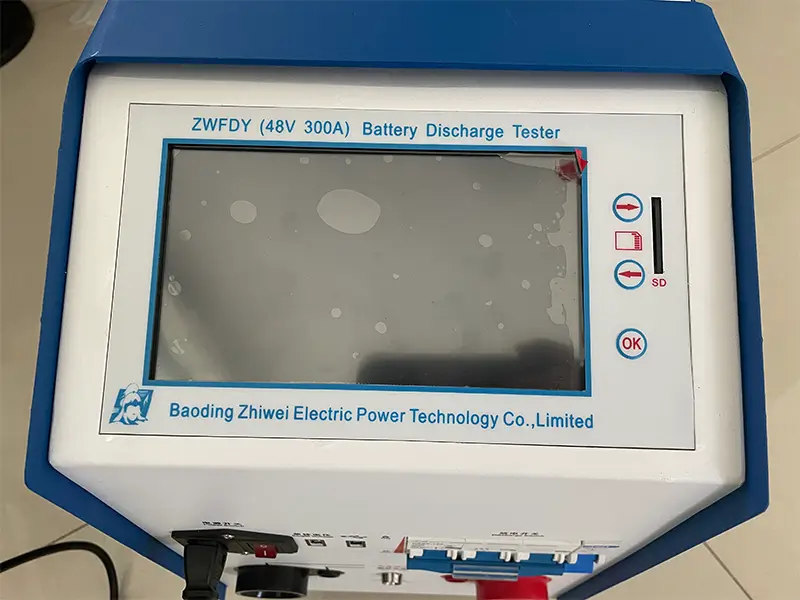
Accurate and safe battery capacity evaluation relies heavily on highly precise, multi-functional, and highly efficient professional testing instruments. If you are searching for a compliant battery diagnostic solution for your power plant, communication base station, or data center, we strongly recommend the ZWFDY-48V125V/300A battery discharge tester.
The ZWFDY Series is a truly smart testing platform custom-built for high-end B2B applications:
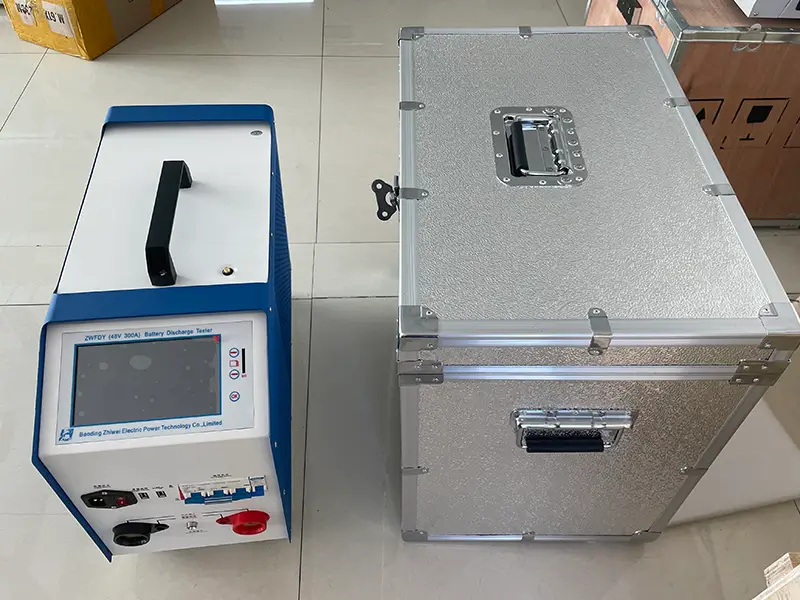
Super Compatibility: A single unit perfectly covers the two mainstream DC systems of 48V and 125V, with discharge currents reaching up to 300A. An ultra-high 380V version can be customized.
Ultimate Safety: Geared with new, integrated low-heat load components, complemented by comprehensive hardware alarm protections like input overvoltage, overcurrent, and reverse polarity.
Digital & Smart Closed-Loop: Comes standard with a 7-inch touch screen, a wireless cell monitoring array, and an incredibly powerful PC software tool. It automatically generates “bar charts, comparison curves, and maintenance suggestions”, keeping the entire capacity test clear at a glance and completely unattended.
Want to learn more about detailed parameters and equipment performance? Click Here to contact our senior technical team right now to get the complete product technical specifications for the ZWFDY series and an exclusive project quote for free.
Our 1-on-1 specialists will provide professional selection guidance, ensuring your backup power system is always in peak condition and ready for action!