
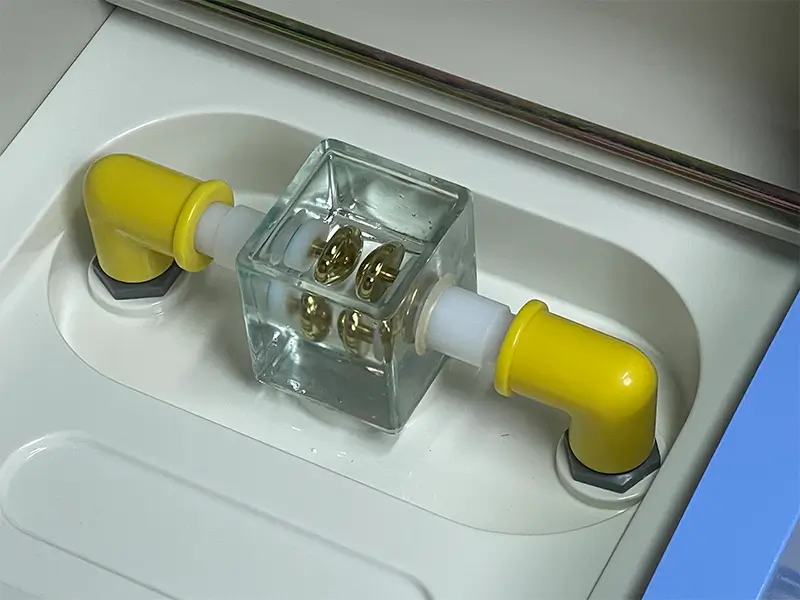
In power transformer condition monitoring and daily maintenance, Breakdown Voltage (BDV) is the most critical indicator for evaluating the dielectric strength of insulating oil. However, when purchasing or operating BDV testers, many electrical engineers often notice that the same batch of oil samples produces different test results on different machines.
The main reason for this difference is usually not the voltage accuracy of the device itself, but the electrode shape used in the testing vessel. Today, major international standards use two completely different electrode designs: spherical electrodes and mushroom electrodes.
Based on the physics of electric fields, this article will explain how these two electrodes affect the detection sensitivity of trace impurities. It will also provide a reliable guide to help you choose the right design according to IEC and ASTM international standards.
The Physics Behind It: Electric Field Distribution and “Dielectrophoresis”
The core principle of the insulating oil BDV test is to apply a continuously rising AC voltage to two electrodes immersed in transformer oil until a discharge breakdown occurs. The shape of the electrodes directly determines how the electric field is distributed between them, which leads to major differences in testing sensitivity.
1. Non-Uniform vs. Uniform Electric Fields
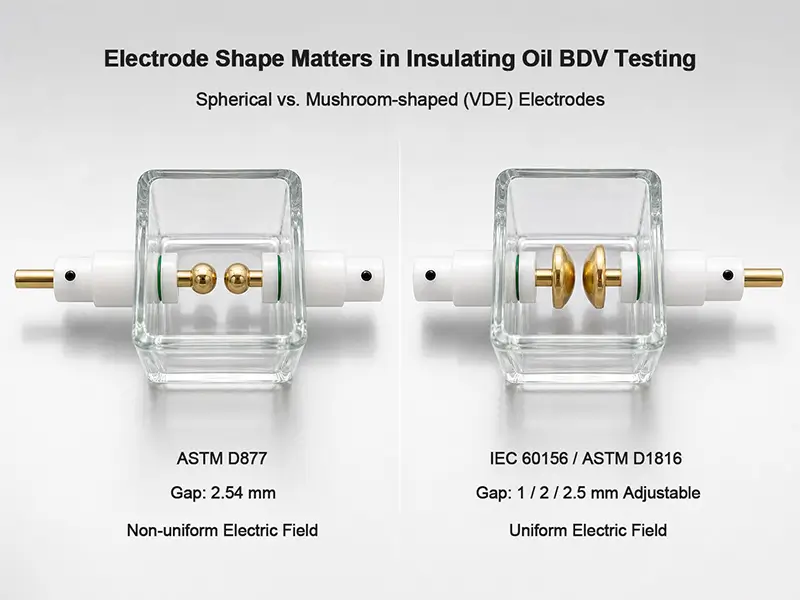
Non-uniform electric field: Created by spherical electrodes. Electrical stress is highly concentrated at the closest point between the two spheres. The area of high electric field strength is very small.
Uniform electric field: Created by mushroom electrodes. Their flat and slightly curved surfaces can form a wide, parallel, and uniform electric field in the center. This closely simulates the real electric field conditions inside modern high-voltage transformers.
2. The Effect of Dielectrophoresis on Impurities
In insulating oil, free water and cellulose particles are the main pollutants that cause insulation failure.
In the wide, uniform electric field created by mushroom electrodes, polar water molecules and impurities are affected by dielectrophoresis forces. They line up along the parallel electric field lines and quickly form an invisible “conductive bridge,” triggering an early breakdown.
In contrast, in the small, non-uniform electric field of spherical electrodes, impurities must happen to float exactly into the narrow center point of high field strength to cause a breakdown. This leads to a higher chance of missing trace amounts of water.
Spherical Electrodes: Features and Applications
Spherical electrodes are made of two perfect spheres, usually brass or stainless steel.
Standard Compliance: Mainly follows the ASTM D877 standard created by the American Society for Testing and Materials.
Electrode Gap: Fixed at 2.54 mm (0.1 inches) according to ASTM D877 rules.
Testing Sensitivity: Due to the limits of a non-uniform electric field, spherical electrodes have low to medium sensitivity to trace water and tiny solid particles.
Best Applications: Used for basic “pass/fail” insulation strength tests. They are mainly good for checking new, unused insulating oil or for routine checks on older, low-to-medium voltage transformers that do not have strict insulation requirements.
EXPERT GUIDANCE
Need Help Choosing the Right Testing Equipment?
Mushroom/VDE Electrodes: Features and Applications
Mushroom electrodes (also known as VDE electrodes) feature smooth contact surfaces with rounded edges.
Standard Compliance: Meets the strictest modern international specifications, including IEC 60156 and the highly precise US standard ASTM D1816.
Electrode Gap: Adjustable, with common fixed gaps of 1 mm, 2 mm, or 2.5 mm (depending on the standard version and test voltage requirements).
Testing Sensitivity: Extremely high. They can easily detect slight moisture or early degradation in the oil.
Best Applications: They are mandatory for testing insulating oil in Extra-High Voltage (EHV) and Ultra-High Voltage (UHV) transformers. In these massive systems, even a few parts per million (ppm) of water can cause a disastrous failure.
When doing a full transformer health check, it’s just as important to check the internal coils as it is to test the oil’s dielectric strength. To learn how to easily find internal faults, you can read our previous tech guide: How to Accurately Test Transformer Turns Ratio and DC Resistance On-Site.
Selection Guide and Parameter Comparison Table
| Comparison Aspect | Spherical Electrodes | Mushroom / VDE Electrodes |
|---|---|---|
| Electric Field Type | Non-uniform | Highly uniform |
| International Standards | ASTM D877 | IEC 60156, ASTM D1816 |
| Sensitivity to Trace Water | Low | Very High |
| Sensitivity to Particle Pollution | Low | Very High |
| Typical Tested Assets | Low/Medium voltage grid equipment, spot checks for incoming new oil | EHV/UHV transformers, precision aerospace electrical equipment |
| Surface Maintenance Requirements | Needs regular polishing to prevent surface pitting | Very strict; must have zero scratches (scratches ruin the uniform electric field) |
Industry Testing FAQ
1. Can we still use spherical electrodes (ASTM D877) to test modern ultra-high voltage transformers?
Strongly not recommended. Modern massive transformers need extremely clean insulating oil. Because spherical electrodes lack sensitivity, they often show artificially high, “overly optimistic” breakdown voltage readings. For EHV/UHV assets, you must use mushroom electrodes (IEC 60156 or ASTM D1816) to see the true level of oil degradation.
2. If our third-party clients want reports for both ASTM D877 and IEC 60156, do we need to buy two separate testers?
No. On professional commercial-grade oil testers, the electrodes are not permanently welded in place. Advanced testing devices allow users to quickly swap out the electrode kits inside the testing vessel. Then, with one click in the software system, you can switch to the matching test preset to perfectly meet multi-national compliance requirements.
Choose ZHIWEI Instruments: Ensure Accuracy and Compliance for Every Test
In modern high-voltage grid maintenance, choosing the wrong testing equipment can lead to false test readings. This might hide tiny faults inside the transformer, eventually causing expensive, unexpected downtime.
Baoding Zhiwei Electric Power Technology Co., Ltd. is deeply involved in developing high-voltage power testing equipment. Our fully automatic flagship insulating oil breakdown voltage tester is designed to meet the strict demands of top labs around the world:
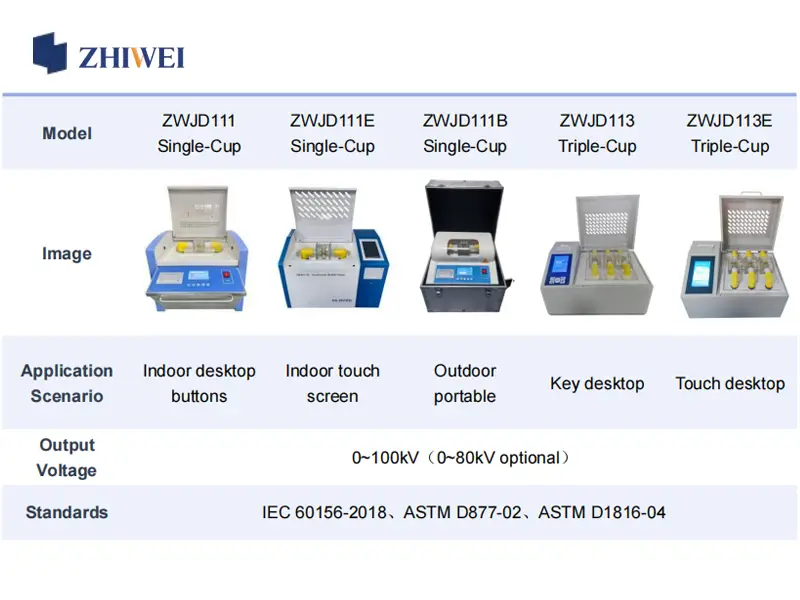
Multi-Standard Compliance: Comes standard with precision-machined spherical, mushroom (VDE), and other fast-swap electrode kits;
Smart Programming System: Built-in automated test programs for the latest versions of IEC 60156, ASTM D1816, and ASTM D877, saving time and labor.
Microsecond Cut-Off Technology: Extremely fast short-circuit protection limits the electrical arc. This stops the test oil sample from being secondarily polluted by carbide, keeping results accurate and repeatable for continuous back-to-back testing.
If your lab or maintenance team needs to upgrade its testing methods to meet EHV compliance, please contact the ZHIWEI engineering expert team today for detailed technical specs and a custom equipment quote.