For many field maintenance personnel, laboratory buyers, and oil testing technicians, evaluating the health of industrial or insulating oils often involves two physical concepts that appear frequently but are easily confused: surface tension and interfacial tension.
While these two terms sound very similar, they represent different physical meanings and reflect different oil issues in actual laboratory testing. Understanding the fundamental difference between these two concepts not only helps us interpret lab reports more accurately but also allows us to catch early signs of oil aging before irreversible equipment damage occurs.
This article provides an in-depth analysis of the differences between surface tension and interfacial tension, focusing on the core significance of interfacial tension in testing transformer oil and other industrial oils.
Table of Contents
Core Definitions: Surface Tension vs. Interfacial Tension
To understand the difference, we first need to define these two concepts from a physical perspective.
What is Surface Tension?
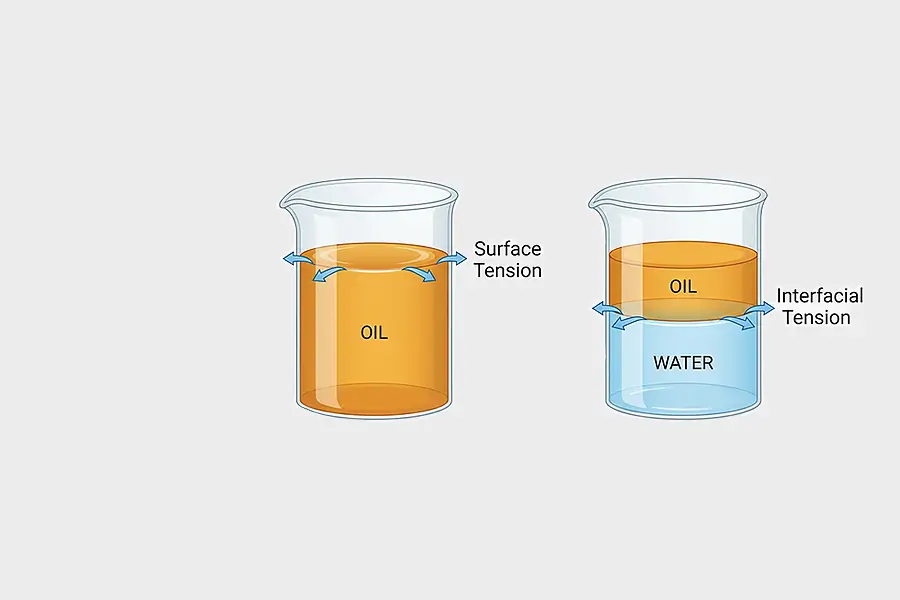
Surface tension refers to the pulling force acting perpendicular to the boundary line between any two adjacent parts of a liquid surface. More simply, it is the force that causes a liquid surface to contract when it comes into contact with a gas (usually air).
There is a cohesive force of mutual attraction between liquid molecules. Inside the liquid, the attraction felt by a molecule from all directions is balanced. However, at the surface, because the gas molecules above are extremely sparse, the surface molecules feel a stronger inward pull than an outward one. This causes the liquid surface to minimize its area, which is why water droplets tend to be spherical in the air.
What is Interfacial Tension?
Interfacial tension refers to the tension at the contact surface between two immiscible fluids (such as two different liquids, or a liquid and a solid). In the field of oil testing, we most commonly talk about oil-water interfacial tension.
When oil and water meet, they do not mix and instead form a physical interface between them. When this interface is stretched, there is an “adhesive force” between the different types of molecules (oil and water) in addition to the unique “cohesive forces” within each liquid.
The magnitude of interfacial tension (usually represented by the Greek letter γ, with units of mN/m or dynes/cm) directly reflects the difference in polarity between the two liquid molecules.
The greater the difference in polarity between the oil and water, the higher the interfacial tension; the smaller the difference, the lower the interfacial tension.
Key Comparison: Surface Tension vs. Interfacial Tension
To help you grasp the differences at a glance, we have organized the following comparison table:
| Comparison Dimension | Surface Tension | Interfacial Tension |
|---|---|---|
| Contact Phases | Liquid vs. Gas | Liquid vs. Liquid, or Liquid vs. Solid |
| Cause | Caused by unbalanced tension on surface liquid molecules | Caused by the difference between cohesive and adhesive forces at the interface |
| Oil Testing Focus | Rarely a focus; only reflects the physical contraction of the oil itself | Highly focused; reflects oil purity and oxidation levels |
| Key Applications | Coating wettability, detergent foaming | Assessing insulation oil aging, detecting polar contaminants |
| Environment Requirements | Affected by the composition of ambient gases | Must be performed strictly between two phases (usually oil and pure water) |
As the table shows, when performing industrial oil testing, the value we truly need to monitor closely is the interfacial tension.
EXPERT GUIDANCE
Need Help Choosing the Right Testing Equipment?
The Core Significance of Interfacial Tension in Oil Testing
Why is the interfacial tension test for transformer oil considered a vital preventive maintenance tool in power and industrial equipment maintenance? The main reason is its extreme sensitivity to the early stages of oil degradation.
Evaluating Oil Oxidation and Sludge Formation
Brand-new insulating oil consists of highly non-polar hydrocarbons, while water is a strongly polar substance. Therefore, the interface between new oil and water creates a very strong repulsive force, resulting in high interfacial tension (usually greater than 40 mN/m).
However, as equipment operates at high temperatures and under electrical stress, the oil gradually oxidizes. The first stage of oxidation produces trace amounts of polar compounds such as alcohols, aldehydes, and organic acids. These polar molecules act like surfactants—one end is attracted to oil and the other to water—gathering at the oil-water interface and significantly lowering the interfacial tension.
Interfacial tension can drop and provide a warning months before conventional Total Acid Number (TAN) tests show any significant change, making it an excellent indicator of insulation oil aging. When the tension continues to drop and passes a critical point, fatal sludge will precipitate in the oil, clogging cooling channels and causing the equipment to overheat.
Detecting Polar Contaminants and Moisture Ingress
In addition to the oil’s own oxidation, the intrusion of external contaminants is also reflected in the interfacial tension.
Examples include the dissolution of insulating varnish, degradation products from solid insulation materials (insulating paper), or the ingress of free water due to poor equipment sealing. All of these increase the polar impurities in the oil, causing a sharp drop in interfacial tension. Timely testing can quickly determine if the transformer requires oil filtration or an oil change.
Interpreting Transformer Oil Interfacial Tension Data
How should field maintenance personnel interpret the data after receiving a laboratory report? Below is a general reference standard for mineral insulating oil (transformer oil) interfacial tension values (tested at a room temperature of 25°C, unit: mN/m):
| Interfacial Tension Value (mN/m) | Oil Condition Judgment | Recommended Maintenance |
|---|---|---|
| > 40.0 | New Oil / Excellent Condition | Excellent state; no intervention needed. Retest on a regular cycle. |
| 30.0 - 40.0 | Good Condition; possible slight oxidation | Within normal operating range. Maintain normal monitoring frequency. |
| 22.0 - 30.0 | Marginal Condition; oil has begun to age | Polar substances have formed. Recommend shortening the test cycle and analyzing TAN and dielectric loss. |
| < 22.0 | Severe Deterioration; sludge about to or already precipitated | Risks equipment safety. Recommend immediate degassing, filtration, or oil replacement. Check transformer coils. |
Note: Specific regulations may vary slightly by country or industry. Please refer to the equipment manufacturer’s manual for actual operations.
Core Test Standard and Method (ASTM D971)
Globally, the most authoritative and widely used standard for interfacial tension testing is ASTM D971 (Standard Test Method for Interfacial Tension of Oil Against Water by the Ring Method). This method primarily uses a Du Noüy ring made of a platinum-iridium alloy.
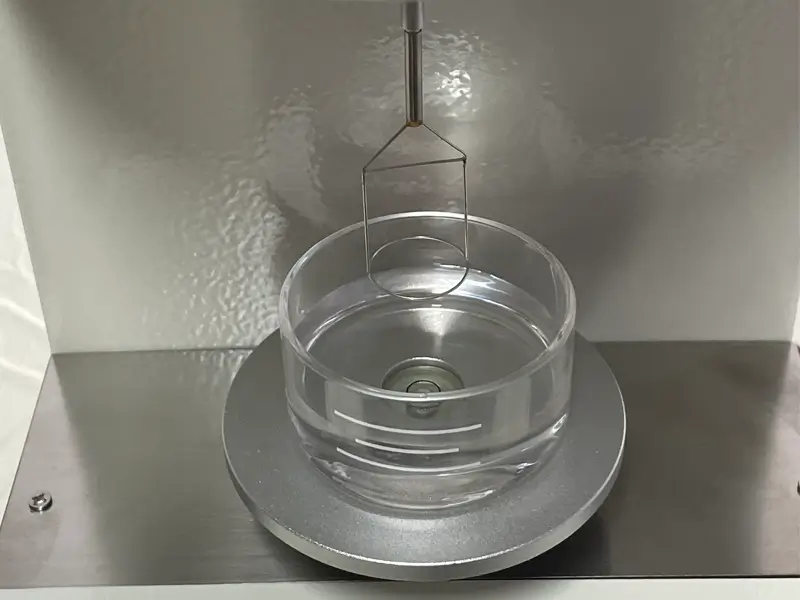
During the test, pure water is first placed in a sample cup, and the oil sample is then carefully layered on top to form a clear interface. Then, a high-precision interfacial tension tester slowly pulls the platinum ring upward from the water phase through the interface. The device precisely measures and records the maximum force required to break the interface.
Since the calculation involves mechanical physics and ring radius correction (F = γ · 4πR · f), traditional mechanical tensiometers suffer from human reading errors and complex calculations. This has led to the widespread adoption of modern fully automatic tensiometers.
Precise and Efficient: Your Decision-Making Tool for Oil Testing
Traditional mechanical tensiometers are not only cumbersome to operate but also rely heavily on the technician’s technique, which can easily lead to “misdiagnosis.”
We provide a fully automatic interfacial tension tester that complies with the ASTM D971 international standard. The ZWZL300 is specifically designed for demanding laboratory oil testing and mobile field repair vehicles, offering the following core advantages:
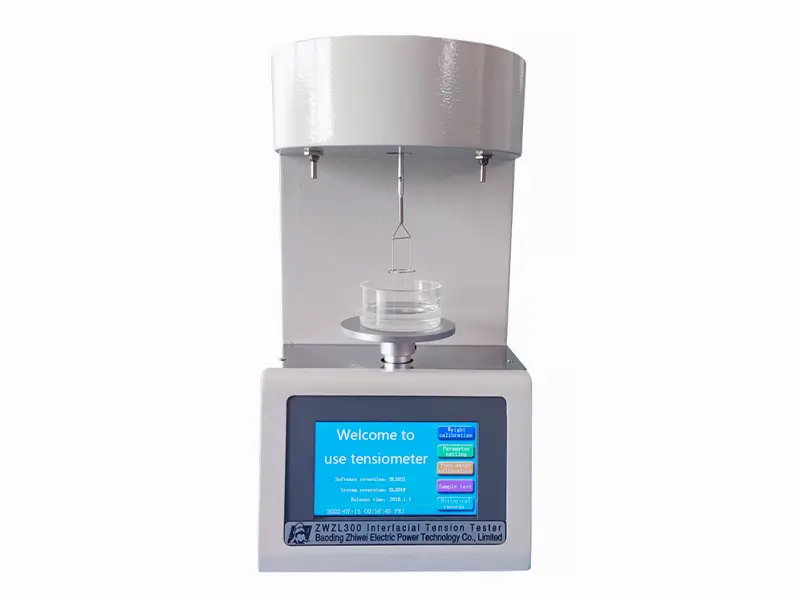
- One-Key Fully Automatic Detection: Automatic lifting, tracking, and ring pulling completely eliminate human reading errors.
- High-Precision Sensor: With a minimum resolution of 0.01 mN/m, it accurately captures even the smallest early signs of oil oxidation.
- Intelligent Built-in Algorithm: It automatically performs tension curve analysis and correction calculations. The final results are displayed directly on a large color touchscreen, eliminating the need for scratch paper and calculators.
- Rugged and Durable: Core components have strong anti-interference capabilities. It comes equipped with a precision platinum ring for calibration, ensuring a long service life.
Frequently Asked Questions
1. When testing transformer oil, do we need to measure surface tension or interfacial tension?
You must test the interfacial tension. Simply testing the surface tension of transformer oil against air has little diagnostic value because it is not sensitive enough to reflect the generation of polar aging products in the oil.
2. Can interfacial tension be measured for high-viscosity industrial gear oils or hydraulic oils?
Yes, but high-viscosity samples have difficulty forming a perfect oil-water interface and are highly prone to emulsification. This usually requires an extended standing time or testing under specific constant temperature conditions. We recommend using a tension tester with an advanced constant temperature function.
3. How often should an interfacial tension test be performed during equipment operation?
For large power transformers, it is generally recommended once a year. If historical data shows the oil is on the edge of aging (such as dropping below 25 mN/m), it is recommended to shorten the interval to every six months or even quarterly to monitor the risk of exponential deterioration.
EXPERT GUIDANCE
Need Help Choosing the Right Testing Equipment?
Conclusion
In this article, we explored the fundamental differences between surface tension and interfacial tension and emphasized why monitoring interfacial tension is a key preventive maintenance step for assessing oil degradation and contamination.
Now that you understand the importance of interfacial tension in oil testing, it is time to take action. Upgrade your laboratory high-precision testing equipment to ensure the long-term reliable operation of your power equipment.
Achieve Precise Oil Testing with ZHIWEI
As experts in transformer oil analysis instruments, ZHIWEI is a trusted supplier of high-end testing solutions. With the ZWZL300 fully automatic interfacial tension tester, we provide automatic operation, high-precision sensors, and smart algorithms to meet the world’s most demanding laboratory requirements.
Our technical team provides expert support and customized services to turn your preventive maintenance vision into reality, fully protecting your core assets.
Contact us today for a real-time quote or product demonstration!