
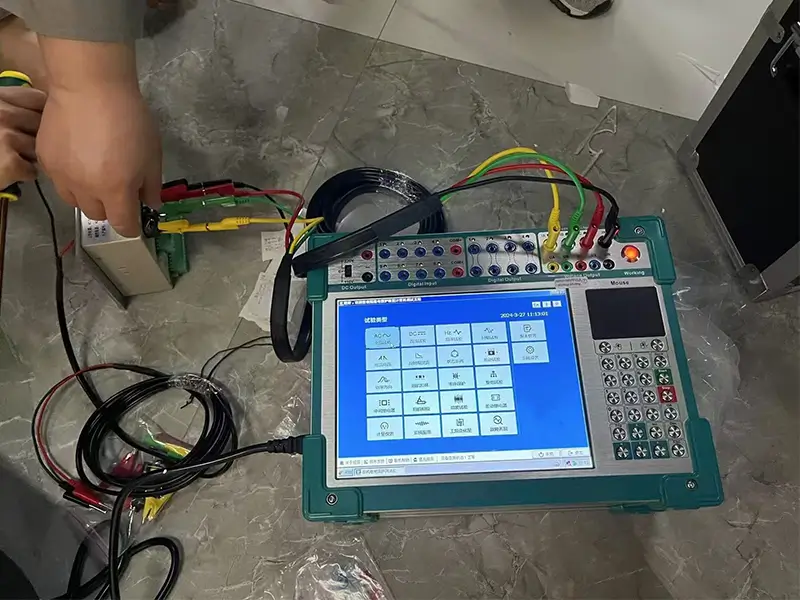
Are you struggling to decide between a portable 3-phase tester or a high-performance 6-phase system? With the rapid evolution of smart grids and IEC 61850 standards, the requirements for relay testing have shifted.
This guide provides a technical roadmap for engineers and procurement professionals. We will analyze why current output matters more than just “high power,” how to choose the right accuracy grade for different relay types, and which software features are essential for modern automated testing. Use this guide to find the perfect match for your specific testing environment.
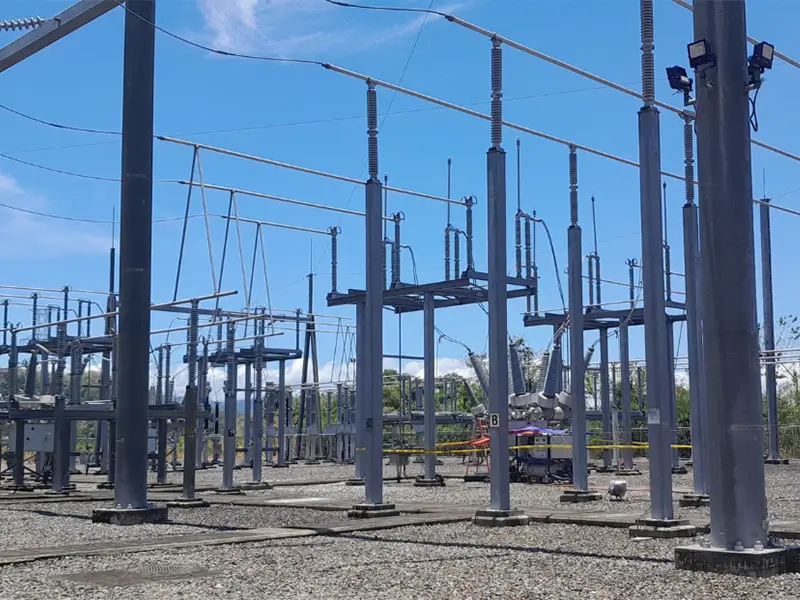
Core Technical Metrics: Beyond Parameters, It’s About On-Site Reliability
1. Voltage and Current Output Channel Configuration
The number of channels directly determines the scope of substation testing the equipment can cover and the on-site work efficiency. Currently, the mainstream relay protection testers on the market are divided into 3-phase (4-phase voltage) and 6-phase systems:
3-Phase Systems (e.g., common 3I/4U configuration):
Suitable for daily calibration of traditional distribution networks, single/three-phase relays, and conventional microcomputer protection devices. Their core advantage lies in high portability (usually weighing around 12.5 kg), making them ideal for distribution network maintenance requiring frequent movement and low-voltage routine testing.
6-Phase Systems (6I/6U configuration):
This is the standard configuration for testing high-voltage and extra-high-voltage substations of 110 kV and above. Having six independent sets of current and voltage means engineers can complete transformer differential protection tests, complex Automatic Transfer Switch (ATS) logic tests, and various phase-to-phase fault simulations in a single run. It eliminates the need to frequently change wiring when testing the high and low-voltage sides, significantly reducing on-site error rates and exponentially increasing testing efficiency.
3-Phase vs 6-Phase Protection Relay Test Sets Comparison:
| Evaluation Dimension | 3-Phase (3I/4U) | 6-Phase (6I/6U) |
|---|---|---|
| Typical Current Range | Single-phase 30A / Parallel 90A | Single-phase 30A / Parallel 180A |
| Main Scenarios | 10kV to 35kV distribution networks and routine testing. | 110kV and above high-voltage substations and power plants. |
| Transformer Differential | Requires frequent rewiring, phase-by-phase testing and complex compensation settings. | Connects high and low voltage sides simultaneously for direct 3-phase 6-channel testing. |
| ATS / Complex Faults | Difficult to fully simulate states of multiple buses and main transformers. | Easily simulates complex grid architectures and State Series. |
| Portability | Excellent (approx. 12−15 kg) | Moderate (approx. 18 kg) |
Purchasing Advice:
Evaluate your future business growth. If it involves main grid construction, transformer differential protection, or complex automation logic testing, a 6-phase protection relay tester is a more forward-looking choice with a better return on investment.
2. Output Accuracy and Waveform Linearity
Accuracy is the soul of a test set, determining the validity and legality of the test results. When purchasing, you must not only look at the “maximum output current,” but also focus on the output accuracy in the core range, the waveform distortion rate, and the underlying hardware architecture:
Hardware Architecture & Accuracy:
Industrial standards require current and voltage output accuracy to be better than 0.2%. Excellent testers adopt a DSP+FPGA structure and 16-bit high-precision DAC output. Through hardware DDS technology, up to 2000 high-density sine wave points can be generated per cycle, ensuring extremely high waveform purity and phase accuracy (0.1°) right from the physical level.
Linear Power Amplifier Technology:
Low-end devices often use switching power amplifiers, which are prone to generating high-frequency burrs (spikes). True high-end relay testers must use high-fidelity Linear Power Amplifiers. This ensures extreme precision when outputting small currents (such as for differential protection threshold testing) and maintains absolute stability when outputting maximum currents (up to 180A in parallel) with rapid cut-offs.
3. Anti-Interference & Standalone Capability for On-Site Closed-Loop Testing
The real-world substation environment is a far cry from a laboratory. Strong electromagnetic interference (EMC) can interrupt communication with or crash an external laptop at any time.
A reliable on-site device should adopt a standalone operating architecture with a built-in high-performance Industrial Personal Computer (IPC). Equipped with a highly interference-resistant embedded Windows operating system and a 10.4-inch/8.4-inch TFT true-color industrial screen, it ensures that even without an external laptop, complex closed-loop tasks like State Series and fault recurrence can be stably executed in strong magnetic fields.
Software Ecosystem for Substation Combat
Hardware parameters determine the equipment’s “physical strength,” while the software ecosystem determines its “intelligence.” Beyond routine AC/DC tests, you should rigorously verify whether the system integrates advanced firmware modules tailored for field engineering:
Full-Scale Differential Test: Does it support custom transformer wiring groups (Y/Y, Y/Δ, etc.) and automatic calculation of balance factors? Can it generate and search for Proportional braking and Harmonic braking characteristic curves with one click?
Impedance Ladder & Distance Protection: Can it set Z1-Z4 zone impedance settings with one click, automatically find various boundaries (circles, polygons, upper/lower circles), and automatically generate test reports with step-like trip times?
Complex Logic & Fault Recurrence (State Series): It must be capable of simulating fault processes of up to 20-40 steps (such as single-phase grounding transient faults, reclosing, post-acceleration operation) and support the seamless import of COMTRADE format field oscillography files, realizing a desktop-level playback of real grid faults.
Supplier Capability Evaluation: How to Avoid Mere “Assembly Plants”?
Excellent B2B procurement is not just about buying testing equipment; it’s about securing a long-term supply chain and technical guarantee. When evaluating suppliers, use the following hardcore details to identify genuine manufacturer strength:
1. Independent Bottom-level Software/Hardware Rights:
Ask if the device supports “software fully automatic closed-loop calibration.” Manufacturers still requiring users to “open the chassis and tweak potentiometers” to calibrate accuracy are usually assembly plants lacking underlying protocol control capabilities.
True R&D factories can automatically complete the calibration and correction of AC accuracy and DC bias using internal algorithms via password commands.
2. Full-Load Protection Design:
Inquire about the instrument’s self-protection mechanisms. A compliant relay tester must feature: voltage loop short-circuit protection and current loop open-circuit alarm/protection mechanisms, alongside overload and overheating safeguards.
Even if an on-site operational error causes a short circuit or a complete open circuit, the equipment will instantly cut off the power amplifier to avoid damage—directly dictating its lifespan in harsh, fast-paced work environments.
Conclusion: How to Make Your Final Choice
- For Routine Maintenance & Portability: If your primary focus is conventional microcomputer protection and relay calibration, a 3-phase system (3I/4U) with 0.2% accuracy is the most cost-effective solution. Its integrated IPC and lightweight design make it ideal for frequent field use in distribution networks.
- For High-Voltage & Complex Systems: For demanding environments like HV substations, a 6-phase system (6I/6V) is essential. It is the only efficient way to perform transformer differential and ATS testing without the time-consuming process of changing wiring, ensuring higher safety and speed.
- The “Pro” Hardware Standard: Don’t settle for less than a DSP+FPGA architecture. To ensure signal purity, prioritize Linear Power Amplifiers over switching types to eliminate waveform distortion—a critical factor for high-precision laboratory and field tests.
- Vendor Reliability: Reliability goes beyond the hardware. Always choose an original manufacturer with deep software expertise (source code level). This guarantees professional calibration support and advanced COMTRADE analysis capabilities that generic resellers simply cannot provide.
FAQ of Protection Relay Test Sets
1. Why is there a time limit on the tester when outputting large currents for inverse-time tests?
A: To protect the high-fidelity linear power amplifier module, professional relay testers automatically introduce a hardware-level time limit when outputting large currents (e.g., over 10A). For instance, the maximum continuous working time for a 30A current might be constrained to within 5 seconds. This fully meets all instantaneous trip testing needs of microcomputer protection while serving as an industry-standard compliant design for the equipment’s self-protection.
2. What is the practical significance of the equipment’s “Jitter Delay” parameter?
A: When testing electromagnetic relays or speed saturation converters, the relay contacts are prone to high-frequency jitter when the parameter approaches the critical trip point. The system’s built-in 10−20 ms (adjustable) anti-jitter delay judgment can effectively prevent the tester from misjudging the trip value due to jitter, ensuring absolutely precise test reports.
3. What should I do if a communication failure or data freeze occurs?
A: Occasional communication interference in strong electromagnetic environments is normal. Industrial-grade relay testers should be equipped with a hardware-level RST (DSP reset button) directly on the panel. A one-click reset allows the underlying chip to re-handshake and establish the USB 2.0 high-speed connection without rebooting the entire machine, guaranteeing uninterrupted on-site testing.
ZHIWEI’s Technical Commitment
Millisecond-level errors and minor waveform distortions can lead to the maloperation or failure to operate of an entire station’s protection logic.
Baoding Zhiwei Electric Power Technology Co., Ltd, as an original manufacturer dedicated to the R&D and manufacturing of power system testing equipment, provides you with comprehensive protection relay testing solutions:
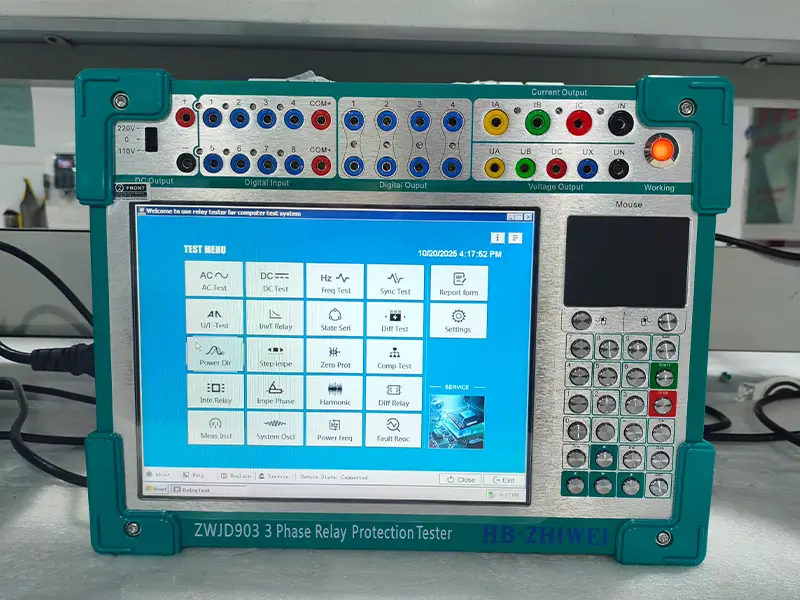
- ZWJD903 3-Phase Microcomputer Relay Test Set (3I/4U): Weighing only 12.5 kg, this compact unit is a highly portable tool for on-site testing in distribution networks and renewable energy stations.
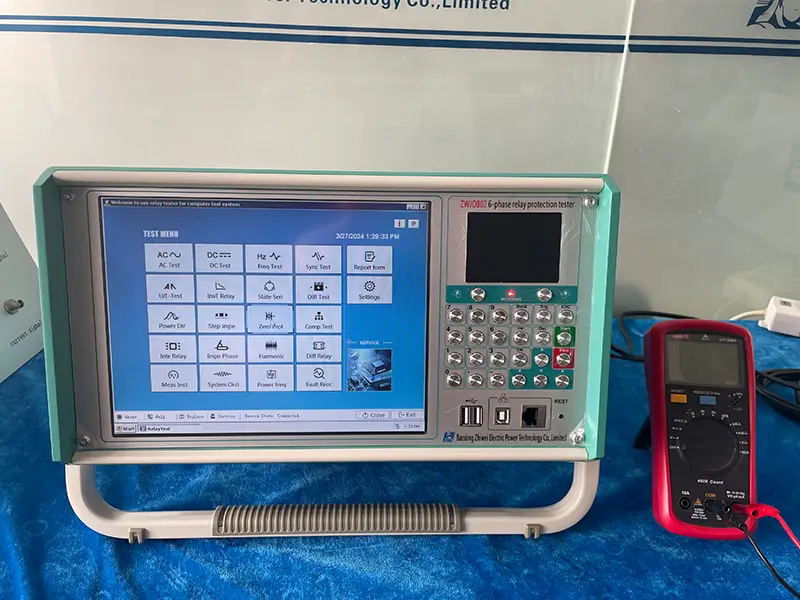
- ZWJD802 6-Phase Microcomputer Relay Test Set (6I/6U): Built on a robust DSP+FPGA and 6-phase linear power amplifier foundation, the entire series is equipped with advanced differential and state series testing modules, serving as the flagship equipment for conquering the complex protection logic of extra-high voltage substations.
All equipment achieves a core accuracy of 0.2% and undergoes rigorous aging and calibration procedures before leaving the factory. Relying on an independently developed software system, ZHIWEI can provide global customers with rapid, custom-level functional upgrades and seamless technical support.
If you are evaluating testing equipment for your next power engineering project, please contact the ZHIWEI engineering sales team today to get the detailed specifications of the ZWJD series, the latest application cases, and the most competitive customized quote for your needs.