
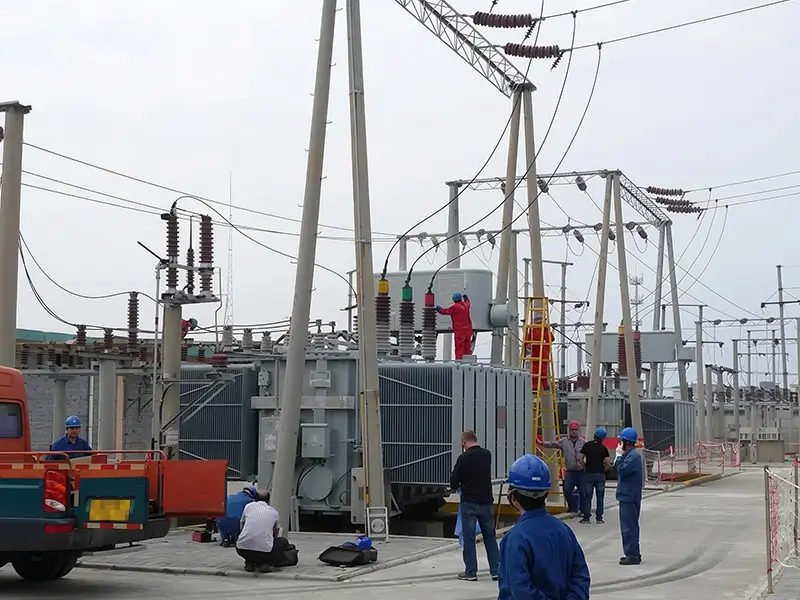
In power grid construction, industrial facility maintenance, and electrical contracting, high-voltage dielectric strength testing on medium and high-voltage cables and equipment is key to keeping power assets running safely.
For decades, DC Hipot testing has been the industry standard for high-voltage insulation tests. However, with the widespread use of modern extruded insulation cables (like XLPE), Very Low Frequency (VLF) cable testing has rapidly emerged. It is now designated by international authorities (such as the IEEE 400.2 standard) as the preferred testing method for medium and high-voltage cables.
Faced with so many high-voltage testing devices on the market, project teams often face a dilemma: What is the fundamental difference between a DC Hipot tester and a VLF tester? Which one should your project choose? This article will give you clear answers based on basic physical principles, effects on cable insulation, real calibration accuracy, and practical application scenarios.
Understanding High-Voltage Insulation Testing
High-voltage withstand testing is essentially a “Go/No-Go” stress test. The goal is to apply a high voltage—much higher than the normal operating voltage—to electrical equipment. This helps uncover potential internal mechanical damage, manufacturing defects, or insulation aging, preventing sudden power outages when the cable is carrying live current.
In a complete predictive maintenance strategy, high-voltage testing is usually divided into two types:
Insulation Resistance Test: Uses a megohmmeter at a low voltage to quickly check for overall moisture or ground shorts.
Dielectric Withstand Test: Applies high voltage (AC or DC) to verify the dielectric strength of the insulation under extreme overvoltage. VLF and DC Hipot are the two main technical routes for this step.
Deep Dive into VLF Cable Testing
What is VLF Testing?
VLF stands for Very Low Frequency. A VLF tester outputs a high-voltage alternating current (AC) signal, usually fixed at a frequency of 0.1 Hz (or 0.05 Hz ~ 0.01 Hz).
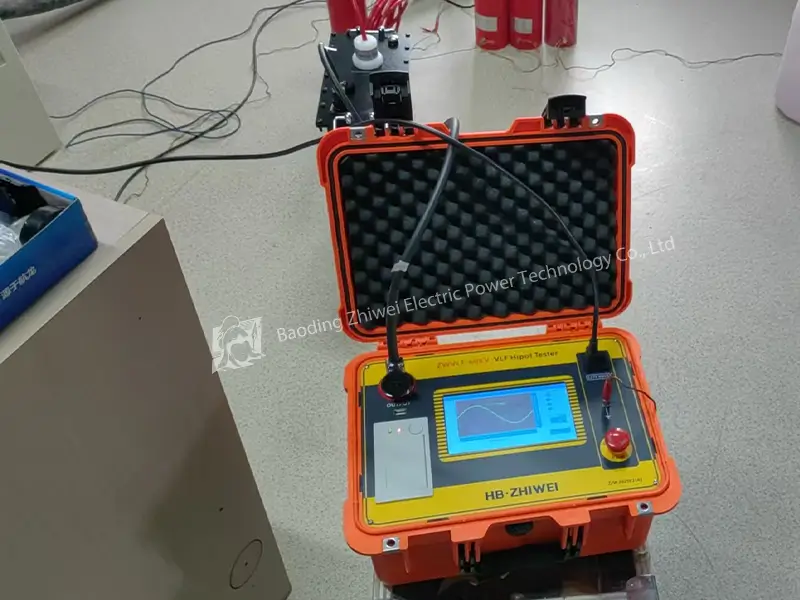
Basic Physics: Reducing Capacity Requirements
For long-distance power cables (which act like a large capacitor C), using a standard 50Hz or 60Hz AC signal for withstand testing requires a very high charging current I:
I = 2πf·C·U
When the frequency f is dropped from 60 Hz to 0.1 Hz (a 600-fold decrease), the required power supply current and capacity drop by 600 times as well. This turns a test transformer that used to weigh several tons into a portable device that one person can carry.
Core Advantages of VLF
Nondestructive Testing: The polarity automatically reverses every 5 seconds (at 0.1 Hz). This prevents space charges from building up in one direction inside the solid insulation.
Meets International Standards: It perfectly aligns with IEEE 400.2 and IEC 60502 standards. It is currently the only widely accepted acceptance test method for medium and high-voltage extruded cables.
Accurately Exposes Hidden Failures: It causes severe “water tree/electrical tree” defects to break down and show up during controlled testing, without damaging healthy insulation.
Understanding DC Hipot Testing
What is DC Hipot Testing?
DC Hipot testing involves applying high-voltage direct current (DC) to the test object and measuring the microampere-level leakage current flowing through the insulation in real time.
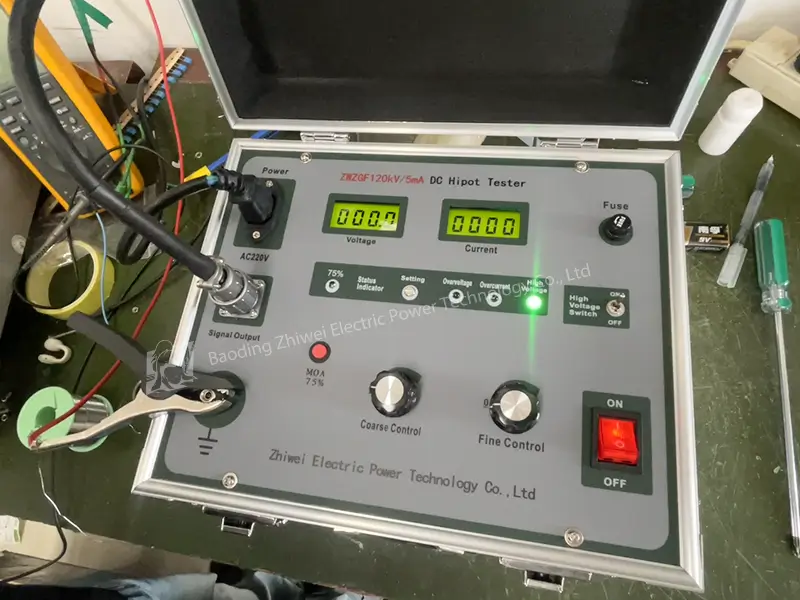
Core Advantages of DC Hipot
Lower Equipment Cost and Lightweight: Because DC does not continuously charge and discharge the cable’s capacitance, the equipment requires very little power to operate.
Clear Resistance and Trend Analysis: It can accurately read the curve of leakage current against testing time (like the 1-min to 10-min absorption ratio). This is very valuable for evaluating whether the overall insulation has taken on moisture.
Metal Oxide Surge Arresters (MOA): When testing the 1mA DC reference voltage and 75% leakage current of a surge arrester, a DC high-voltage generator is an irreplaceable tool.
Key Comparison: VLF Cable Testing vs. DC Hipot
The “Space Charge Effect” in XLPE Cables
Why do international electrical standards strictly ban using DC Hipot to test aged solid extruded cables like cross-linked polyethylene (XLPE) or ethylene propylene rubber (EPR)?
The Hidden Damage of DC Testing: When high-voltage DC is applied to non-polar XLPE solid insulation, the strong electrical field forces electrons into microscopic air gaps inside the material, creating a buildup of space charges. After the DC test ends and the cable is reconnected to the 50Hz AC power grid, this leftover electrostatic field overlaps with the grid’s AC field. This creates localized stress that is many times greater than the design value, triggering fatal electrical treeing. This can directly cause the cable to blow out and fail within days or weeks after power is restored!
The VLF Solution: VLF outputs alternating current (AC) with alternating polarity. It never creates space charges, making it absolutely safe for XLPE cables.
Comparison Table: VLF vs. DC Hipot
| Comparison Dimension | VLF AC Withstand Test (ZWVLF) | DC High Voltage Generator Test (ZWZGF) |
|---|---|---|
| Test Output Waveform | 0.1Hz Sine Wave AC | Pure High-Voltage DC |
| Safety for XLPE/EPR Solid Cables | Absolutely safe (no space charges) | Extremely dangerous (IEEE strictly bans use on aged XLPE) |
| Accurate Leakage Current Measurement | Focuses on overall dielectric loss and withstand strength | Extremely precise (microampere-level μA leakage current monitoring) |
| Specialized Arrester (MOA) Testing | Not applicable | Perfect match (tests 1mA reference voltage and 75% leakage) |
| Older Paper-Insulated Lead-Covered (PILC) Cables | Fully applicable and safe | A traditional and effective test method |
| Mainstream International Standards | IEEE 400.2, IEC 60502 | IEEE 95, IEEE 400.1 |
Real Factory Calibration Reports and Hardware Accuracy Check
No matter which technology you choose, the real output accuracy and hardware stability of the device are your last line of defense for a safe test. Below is real calibration data from the latest batch of equipment from the Baoding Zhiwei Laboratory:
1) Zhiwei ZWVLF 80kV VLF Withstand Tester (Serial Number: 20241025084)
Double-calibrated with a 100kV class 0.5 standard voltage divider and a UT73 digital multimeter to ensure the test high voltage is accurate and steady:
Table 1: ZWVLF 80kV Voltage and Current Inspection Record
| Standard Divider Input (kV) | ZWVLF Measured Output (kV) | Standard Calibration Current (mA) | ZWVLF Measured Current (mA) |
|---|---|---|---|
| 10.0kV | 10.1kV | 5.5mA | 5.6mA |
| 30.0kV | 30.2kV | 10.8mA | 10.7mA |
| 60.0kV | 60.5kV | 15.3mA | 15.1mA |
| 80.0kV | 80.9kV | 21.9mA | 21.6mA |
Calibration Conclusion: Voltage error is kept under ≤1% across the entire range. The complete package comes with an anti-recoil discharge rod, a self-test capacitor, and special high-voltage connection cables to guarantee that the 0.1Hz high-voltage pulse is absolutely safe on site.
2) Zhiwei ZWZGF 120kV/5mA DC High Voltage Generator (Serial Number: 202707)
Calibration Environment (15-35°C, 45-75% RH). The hardware includes a built-in shock-resistant microammeter and a Bluetooth data transfer module:
Table 2: ZWZGF 120kV/5mA DC High Voltage and Leakage Current Inspection Record
| Output Standard Voltage | Control Box Value (kV) | Standard Test Current (μA) | Shock-resistant Microammeter Value (μA) | Control Box Value (μA) |
|---|---|---|---|---|
| 10.00kV | 9.9kV | 50.00 μA | 49.9 μA | 48 μA |
| 60.00kV | 60.0kV | 1000.0 μA | 1000 μA | 1000 μA |
| 120.00kV | 120.1kV | 5000.0 μA | 5000 μA | 5009 μA |
Practical Arrester Test: For a 10kV arrester, the 1mA reference voltage is 27.1kV, and the 75% leakage current is only 5.2 μA. This fully meets the standard factory requirements.
Predictive Maintenance Selection Guide
How can you make the best investment decision for your project? Just follow this simple decision logic:
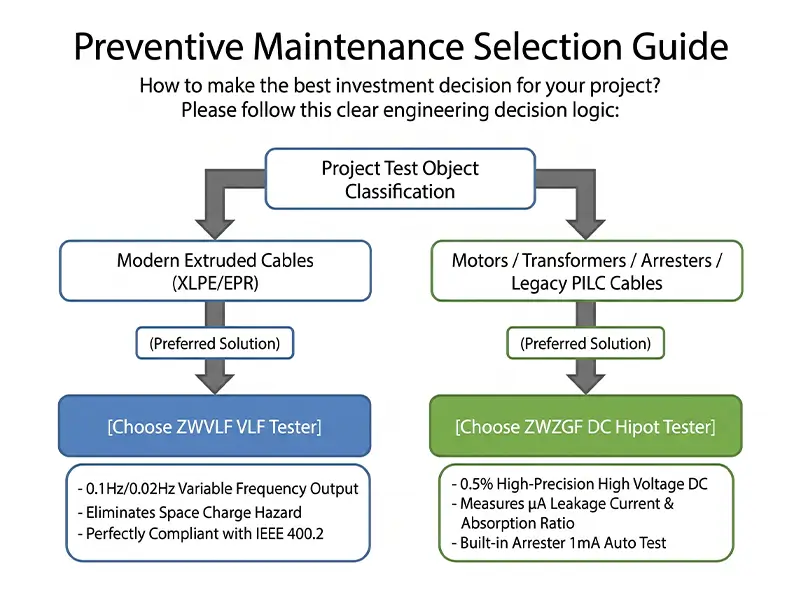
If your project involves modern medium and high-voltage cables (XLPE/EPR): Choose the VLF tester.
This complies with IEEE 400.2 and is the only option that guarantees the cable will not suffer hidden damage after testing.
If your project mainly deals with generator stator windings, transformers, zinc-oxide arresters, or traditional PILC (paper-insulated) cables: A DC Hipot Generator is still a highly cost-effective tool that offers the most precise leakage current measurement.
Frequently Asked Questions (FAQ)
Q1: Can I use a DC Hipot tester on XLPE cables?
It is highly discouraged. According to IEEE standards, high-voltage DC will leave a severe space charge buildup in solid insulation like XLPE. When the cable returns to normal AC operation, the overlapping electrical fields will cause the insulation to quickly undergo “electrical treeing.” This can easily cause the cable to catch fire and be destroyed shortly after power is restored.
Q2: Is VLF testing considered AC or DC?
VLF is a true AC test. Even though the frequency is very low (usually 0.1 Hz, meaning the polarity switches between positive and negative every 5 seconds), the voltage waveform continuously alternates. This perfectly prevents any DC charge buildup.
Q3: Which test is better for older paper-insulated lead-covered (PILC) cables?
Both are perfectly fine. DC Hipot has been the standard practice for PILC cables for decades because paper insulation does not suffer from DC space charge problems like XLPE does. However, VLF is also equally safe and effective for testing PILC cables.
Q4: Can VLF or DC withstand testing replace standard insulation resistance (Megger) testing?
No, it cannot. The two tests complement each other. The insulation resistance test (Megger) is a preliminary screening done at low voltage to check for severe ground shorts or heavy moisture. VLF and DC Hipot tests, on the other hand, apply high voltage beyond the rated voltage to verify the overall dielectric strength of the insulation.
EXPERT GUIDANCE
Need Help Choosing the Right Testing Equipment?
Conclusion
Choosing the right testing equipment does more than just ensure accurate data—it directly protects your substation assets and keeps your field engineers safe. Ultimately, VLF is your modern, safe, and nondestructive choice for cable testing. Meanwhile, DC Hipot stands strong as a cost-effective and essential tool for diagnosing generator windings and arresters.
Find the Right Equipment for Your Project
Baoding Zhiwei Electric proudly offers both the ZWVLF series VLF testers and the high-precision ZWZGF series DC High-Voltage Generators, all featuring top-level laboratory calibration accuracy.
Not sure which model best meets your specific voltage or cable length requirements? Let us help you make the right choice!
Contact us today to request our complete dielectric testing equipment catalog, get customized selection advice, and receive the latest product quotes.
📧 Email us at: sales001@zhiweielectric.com