
I. Introduction: The Ignored “Zero-Point” Drift
In the condition monitoring of power transformers, the acid value is a core indicator for assessing the aging level of insulating oil. However, the acid value testing of transformer oil is usually at a very low range. The acid value of high-quality or newly-run transformer oil is often between 0.002 and 0.1 mg KOH/g.
In such a trace testing environment, any tiny external interference will be infinitely magnified. Many laboratory and maintenance staff often face a pain point: the test results of different batches fluctuate noticeably. After thorough investigation, the real cause of data drift is often not the deterioration of the oil sample itself, but a change in the “background noise” of the testing system.
To eliminate this interference and ensure the absolute integrity and authenticity of the data, blank titration becomes a crucial step in the testing process. This article will dive into the scientific principles of blank titration and how the ZWYG-3 fully automatic acid value tester perfects this key step through its core algorithms and process optimizations.
II. Deep Analysis: Why Can’t Reagents be Deemed “Absolutely Neutral”?
Traditionally, lab technicians tend to assume that newly mixed extraction fluids are completely neutral. However, the chemical reality is quite different.
The extraction fluid used for transformer oil acid value testing is usually a mixture of isopropanol and petroleum ether. During storage and transfer, the extraction fluid easily goes through the following physical and chemical changes:
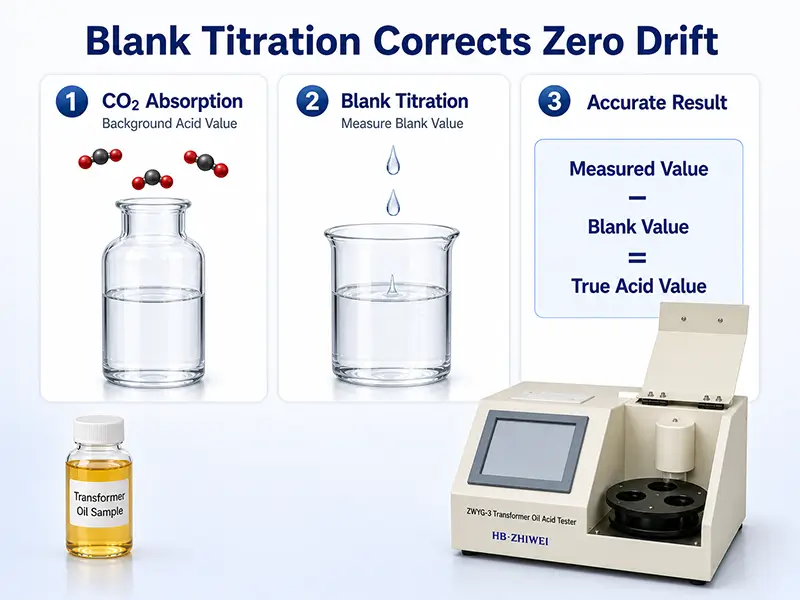
- Absorbing carbon dioxide (CO2) from the air: When CO2 from the air dissolves in the reagent, it forms a trace amount of carbonic acid, directly making the extraction fluid slightly acidic.
- Weak oxidation reaction: Under light exposure or temperature changes, the solvent itself may undergo a slow oxidation reaction, producing tiny acidic by-products.
- Consequences of magnified errors: If the background acid value of the extraction fluid itself is not subtracted during the test, this “extra” acidity will be directly added to the final calculation, causing the measured oil acid value to be higher than it actually is. In strict asset assessments, such inaccurate data could lead to a serious misjudgment of the transformer’s aging level, and even trigger unnecessary downtime for maintenance.
Because of this, the international ASTM D974 standard guidelines set extremely strict rules for the blank verification of reagents. It clearly states that a blank test must be run on the titration solvent to eliminate system errors.
III. Process Details: How Does the ZWYG-3 Handle Blank Titration?
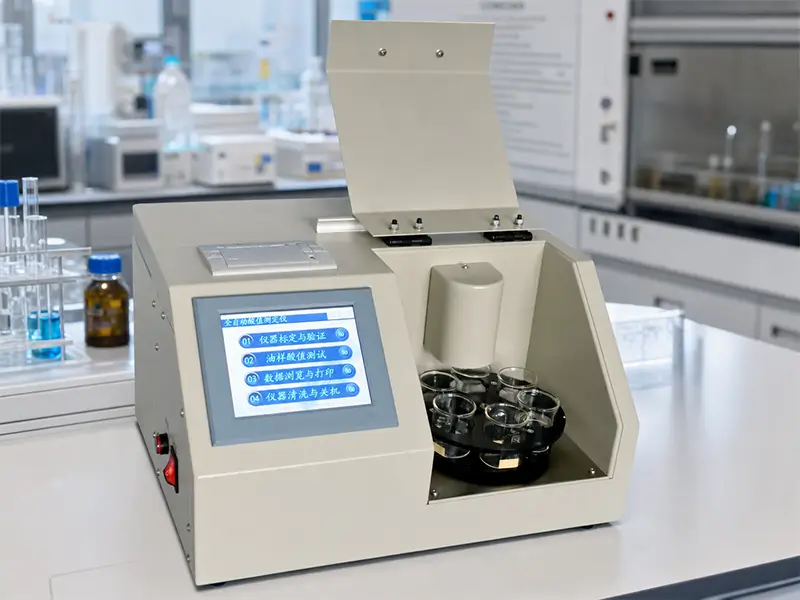
To completely remove the interference caused by reagent background values, the ZWYG-3 fully automatic acid value tester introduces a highly automated blank titration and calibration mechanism in its core technical design.
1. Smart Auto-Deduction Technology
The ZWYG-3 sets blank titration as a required step before the standard testing process. The device automatically draws a fixed amount of extraction fluid for an independent titration, accurately measuring its current background acid value. In the following real oil sample tests, the system’s built-in microprocessor uses a formula to automatically subtract this blank value from the final result, outputting a highly accurate “net acid value”.
2. Dynamic Calibration and Maintenance Guide
Reagent concentration is the foundation for calculating the acid value. The ZWYG-3 system is equipped with a 0.15 mol/L standard acid solution. When the user changes the neutralization fluid or switches to a new batch of extraction fluid, the system smartly guides the user to run the calibration process. This dynamic calibration mechanism ensures that the device is always operating on the best baseline.
3. Environmental Protection: Isolating Interference from the Source
For titration systems, “prevention” is better than “cure”. The ZWYG-3 features a specially designed gas-washing bottle in its hardware. This design can effectively filter out acidic components (such as CO2 and SO2) from the air entering the machine, ensuring the gas environment inside the titration loop always stays pure and neutral. This physical isolation greatly reduces random fluctuations in blank values right from the source.
Table 1: Comparison of Blank Titration Methods: Traditional vs. ZWYG-3
| Comparison Dimension | Traditional Manual Titration | ZWYG-3 Fully Automatic Titration System |
|---|---|---|
| Background Value Processing | Requires manual recording and subtraction calculation, prone to errors | System automatically measures, records, and subtracts it from the final result |
| Environmental Interference Control | Reagents are exposed to air and easily absorb impurities | Closed pipeline + KOH gas-washing bottle isolates acidic substances in the air |
| Calibration Convenience | Requires manual mixing of standard solutions and tedious calibration | Built-in 0.15 mol/L standard acid, system-guided one-click calibration |
IV. Technical Advantages: How Fully Automatic Processes Protect Data
1. The “20 Continuous Titrations Judgment Mode” that Eliminates Human Interference
Manual blank titration relies heavily on the tester’s naked eyes to spot the instant color change of the indicator. Different people have subjective differences in defining a “slight color change.” Especially at very low ranges, this subjectivity is a fatal source of error.
The ZWYG-3 completely drops manual visual judgment and adopts an advanced 20 continuous titrations judgment mode. The system monitors the reaction status in real-time through highly sensitive optical sensors.
The algorithm will only objectively lock the titration end-point when a specific state remains stable for the required number of drops. This strict judgment logic ensures that every data point is 100% objective and repeatable.
2. Highly Efficient 1-3 Cup Linkage Architecture
While chasing the highest accuracy, the ZWYG-3 does not give up testing efficiency. Its unique 1-3 cup linkage design means users only need to do one blank calibration at the first cup position. After that, the system can use this baseline data to continuously and automatically finish accurate measurements for several subsequent oil samples. In bulk testing tasks, this perfectly balances “high data accuracy” and “high operating efficiency”.
EXPERT GUIDANCE
Need Help Choosing the Right Testing Equipment?
V. Frequently Asked Questions (FAQ)
1. Why must a blank titration be run every time reagents are changed?
Because different batches of extraction fluid, or reagents stored in the lab for a while, will have slight changes in their chemical background values due to environmental factors. Without blank calibration, the reagents’ own acidity will be counted into the oil sample, causing an irreversible, accumulated error that directly affects compliance with the ASTM D974 standard.
2. How does the ZWYG-3 ensure titration accuracy in high-humidity or harsh environments?
The machine’s accuracy comes from its closed liquid circuit design. Relying on its built-in absolute ethanol cleaning system and a highly efficient potassium hydroxide (KOH) gas-washing bottle, the ZWYG-3 constantly absorbs moisture and acidic gases from the air entering the pipeline, keeping the inner pipeline dry and completely neutral at all times.
3. What could be the reason if the blank value is unusually high during a test?
There are usually two main reasons. First, the storage container for the extraction fluid is poorly sealed, allowing it to absorb a lot of carbon dioxide from the air and spoil. Second, the internal peristaltic pump tube has aged or stuck together after prolonged use, causing contamination from old residues. We suggest checking the product manual to regularly inspect the reagent seals and maintain the pump tube system.
VI. Conclusion
In this post, we explored why blank titration is the absolute key to precision in transformer oil acid value testing, and how ignoring background noise can lead to critical data drift. We also demonstrated how the ZWYG-3 Fully Automatic Acid Value Tester eliminates these variables through its automated flow and intelligent calibration.
VII. Upgrade Your Oil Analysis with Zhiwei Electric
With over 20 years of industry expertise, Zhiwei Electric is a trusted global provider of complete power testing solutions. Through our strict ‘3-Stage Quality Control’, we deliver laboratory-grade accuracy that outperforms standard equipment, helping you reliably safeguard critical infrastructure across the power, oil & gas, and railway sectors.
To get an instant quote or technical consultation, contact us now!