
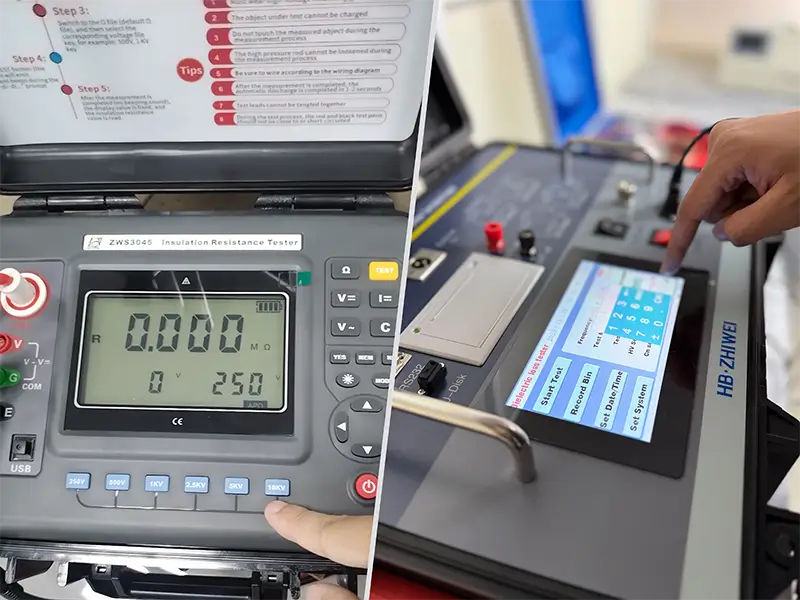
In the predictive maintenance of high-voltage electrical equipment, accurately assessing the insulation condition is the foundation for ensuring stable power system operation. However, many field engineers often encounter a frustrating situation: the equipment has just passed the insulation resistance test, but a severe insulation breakdown still occurs shortly after it is energized and put into operation.
This is because insulation degradation is a complex process. A single testing method cannot provide a comprehensive insulation diagnosis. According to authoritative industry standards such as IEC 60076 and IEEE 43, both insulation resistance testing and dielectric loss testing are core diagnostic technologies.
Although both are used to evaluate insulation integrity, they measure different electrical parameters and focus on different diagnostic goals. They are not substitutes for each other; rather, they are complementary methods that must be used together to achieve a complete diagnosis.
This article will explain the working principles and technical parameter differences of these two tests, as well as their synergistic role in maintaining transformers and high-voltage cables.
I. Testing Basics: Detection Principles
Insulation Resistance Testing
The insulation resistance test is performed using a megohmmeter. Based on Ohm’s law (R=U/I), it applies a high DC voltage to the equipment’s insulation and measures the leakage current flowing through the insulating medium. This calculates the total insulation resistance value, measured in MΩ or GΩ.
This test is extremely accurate for identifying large-scale, severe insulation defects, such as extreme moisture ingress, physical damage, and direct short circuits. Its main purpose is to determine whether the equipment currently has basic insulation capabilities, providing a safety prerequisite for subsequent high-voltage tests.
Dielectric Loss Testing
Dielectric loss testing is used to detect energy loss inside the insulation material. During the test, the instrument applies an AC voltage to the equipment. In an ideal capacitive insulating medium, the current phase should lead the voltage by 90°. However, as the insulation gradually ages, absorbs moisture, or is eroded by dirt, an additional resistive leakage current (IR) is generated in the medium. This causes the total current phase to deviate from 90°, creating an offset angle δ.
Calculation formula: Tanδ = IR/IC (the ratio of resistive current to capacitive current).
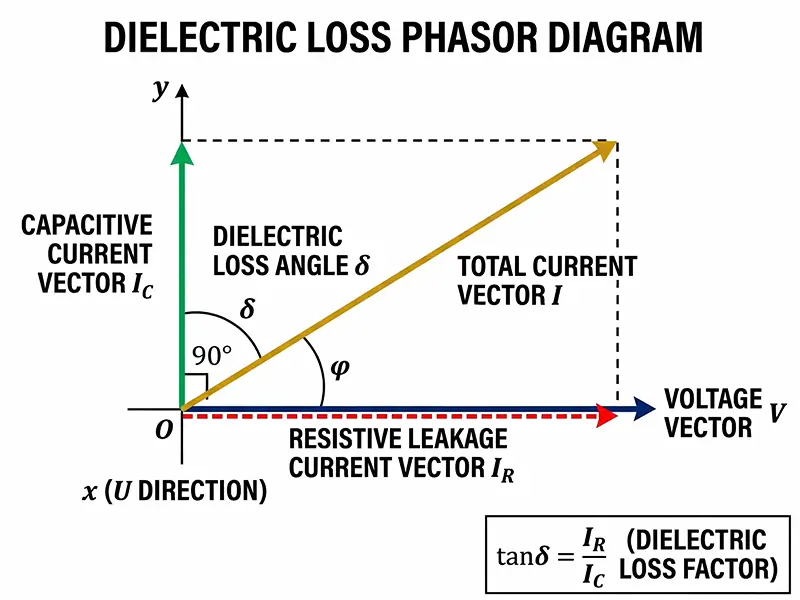
This test is highly sensitive. It can detect local microscopic degradation hazards months or even years before a physical insulation breakdown actually occurs.
II. Core Parameter Comparison: IR vs. Tan Delta
To show the technical features of both methods more intuitively, please refer to the comparison table below:
| Parameter | Insulation Resistance Testing | Dielectric Loss Testing |
|---|---|---|
| Applied Voltage | High DC voltage | High AC voltage |
| Main Measurement | Insulation Resistance (MΩ/GΩ) | Tangent of the phase offset angle (Tanδ) |
| Defect Detection Capability | Severe moisture, physical cuts, direct short circuits, etc. | Water treeing, thermal aging of insulation paper, localized carbonization, etc. |
| Sensitivity to Aging | Low. The resistance value might remain in the “acceptable” range even just a few days before a fatal failure. | High. Can quantify and track the progressive degradation curve of the material over time. |
| Instrument Complexity | Simple, portable insulation resistance testers with a lower purchase cost. | Complex, requiring a high-voltage AC source and a precision measurement bridge; these are advanced dielectric loss testers. |
III. Diagnostic Limitations: Why is Insulation Resistance Testing Alone Not Enough?
Real-world testing experience from our technical teams at multiple substations worldwide shows that relying solely on insulation resistance testing leaves huge blind spots in equipment condition-based maintenance.
Because IR testing uses DC voltage, the DC current tends to flow along the path of least resistance. If there is localized water tree aging in a high-voltage cross-linked polyethylene (XLPE) cable, the intact insulation surrounding it will still block a large amount of DC current. This makes it highly likely that the tester will return a “pass” or “acceptable” IR value.
However, when the equipment is put into power-frequency AC operation, these microscopic defects will cause dielectric heating and partial discharge under the alternating electric field, eventually leading to a sudden insulation breakdown.
Tan Delta testing uses AC excitation and can accurately capture these distributed microscopic defects.
In short, passing the insulation resistance test only reflects the equipment’s current insulation condition, whereas a dielectric loss test reveals the aging level and remaining service life of the insulation material.
EXPERT GUIDANCE
Need Help Choosing the Right Testing Equipment?
IV. Industry Standard Operation: A Two-Step Complementary Diagnostic Solution
For core high-voltage assets like transformers, these two tests are absolutely not an “either/or” choice. Instead, they form a standardized process that must be used together in a strict sequence.
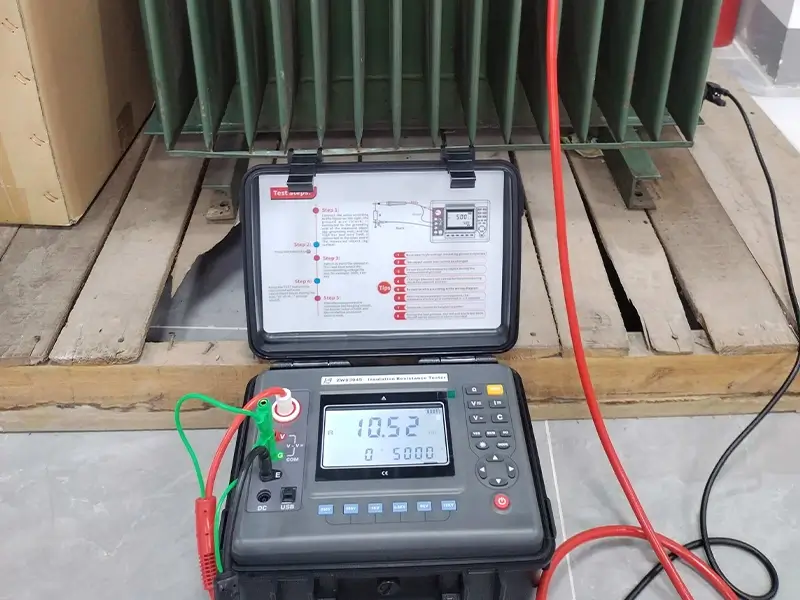
Step 1: Perform the Insulation Resistance Test (Safety Pre-Screening)
Before conducting the AC dielectric loss test, you must first perform an IR test. This is to check if the equipment has a severe short circuit. If a high-voltage AC signal is applied directly to a cable with severe physical damage, it is highly likely to cause a secondary short circuit explosion. If the IR test fails, you should stop further testing immediately and schedule maintenance.
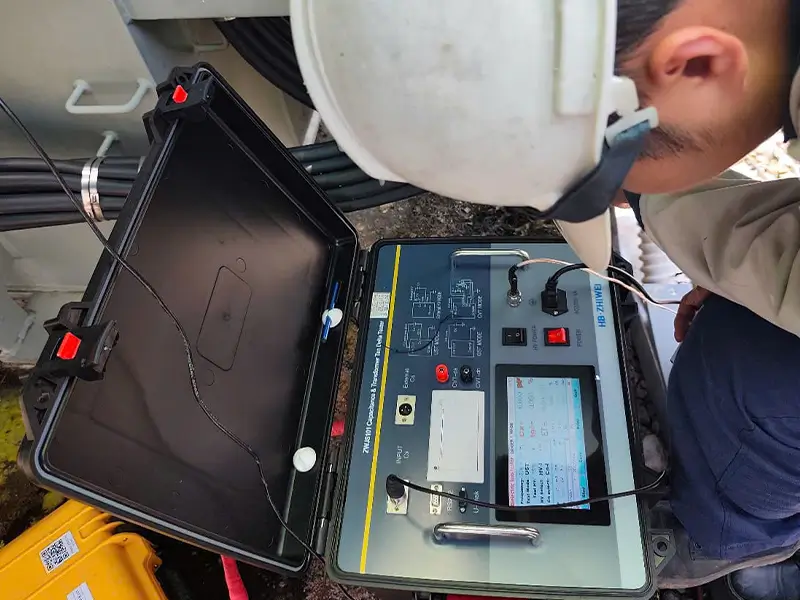
Step 2: Perform the Dielectric Loss Test (Aging Depth Prediction)
Once the IR test confirms the equipment meets basic safety conditions, perform the Tan Delta test. Compare the measurement results with factory baseline values and historical data. If the dissipation factor continues to rise, you should schedule equipment replacement during a planned outage window to avoid unplanned downtime.
V. Frequently Asked Questions
1. Can dielectric loss testing completely replace insulation resistance testing?
A: No. The IR test is an indispensable safety prerequisite. Skipping the IR test and moving directly to the dielectric loss test not only violates safety protocols but can also damage the dielectric loss testing instrument.
2. How long should the dielectric loss testing cycle be for high-voltage transformers?
A: Critical backbone transformers are usually tested every 3 to 5 years. However, if the transformer experiences severe overvoltage from a lightning strike, or if the Dissolved Gas Analysis (DGA) of the insulating oil shows abnormal results, you need to schedule additional tests immediately.
3. Can Tan Delta testing accurately locate specific fault coordinates on a cable?
A: No. Tan Delta is a volumetric, overall testing method. It reflects the overall average aging level of a section of cable. If you need precise physical coordinate localization, it must be used in conjunction with Time Domain Reflectometry (TDR) or a Partial Discharge (PD) location system.
VI. Conclusion: Building Data-Driven Predictive Asset Management
Combining insulation resistance testing with dielectric loss testing is a fundamental method for the preventive maintenance of high-voltage electrical assets. The IR test verifies the current safety status of the equipment, while the Tan Delta test evaluates the long-term health trends of the insulation material. Together, they create a complete insulation diagnostic solution.
EXPERT GUIDANCE
Need Help Choosing the Right Testing Equipment?
Choose ZHIWEI to Ensure Your Testing Accuracy and Data Consistency
In environments with strong electromagnetic interference like substations, a testing instrument’s anti-interference ability directly affects the reliability of the diagnostic data.
Baoding Zhiwei Electric Power Technology Co., Ltd focuses on developing and manufacturing internationally compliant Tan Delta testing systems and high-precision insulation resistance testers. Our equipment features built-in advanced filtering algorithms to ensure stable and repeatable test data in complex industrial environments.
Whether you are looking to upgrade your existing power grid testing standards or find a reliable B2B supplier for testing instruments, ZHIWEI can provide professional technical support.
For product technical manuals or to request an equipment demonstration, please contact the ZHIWEI engineering team.