
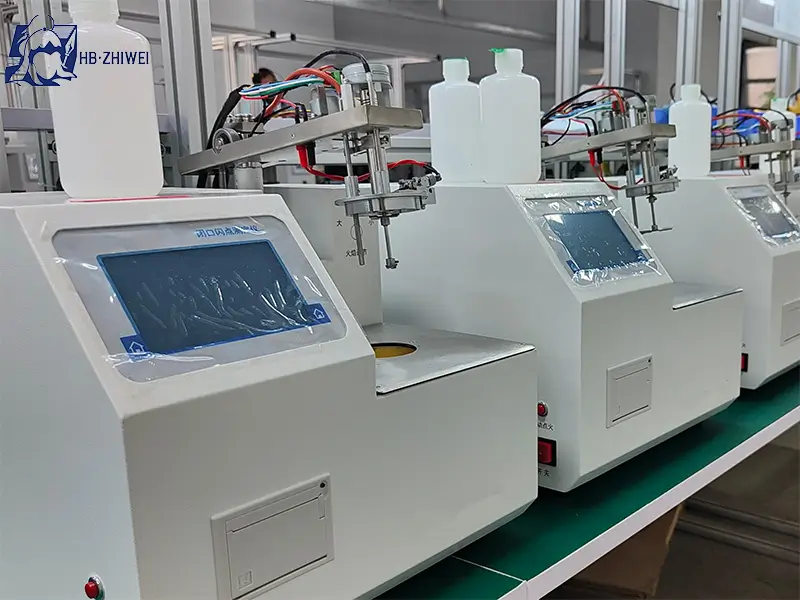
Flash point is a critical safety metric in petrochemical analysis, strictly determining compliance in production, transportation, and storage.
Choosing between “Open Cup” and “Closed Cup” methods is a common challenge. Relying solely on routine without understanding the underlying principles can lead to methodology errors, especially when dealing with complex samples or evolving regulations. Such missteps not only invalidate data but also invite significant compliance risks.
This article delves into the root of these standards, analyzing the fundamental differences and application boundaries of both methods. We aim to help you identify the safest and most compliant testing solutions.
.webp)
Core Difference: Confined vs. Exposed Environments
To select the correct testing method, the key lies in understanding which distinct real-world environment they simulate. This directly determines whether your test results hold practical significance.
Closed Cup Method – Simulating Confined Environments: The sample is heated within a sealed container, preventing vapors from escaping. This simulates confined storage and transport conditions like fuel tanks and sealed drums. Since vapors accumulate, they reach a combustible concentration faster; consequently, the resulting flash point is typically lower, providing stricter safety data.
Open Cup Method – Simulating Exposed Environments: The sample is heated in an open vessel, allowing vapors to diffuse into the air. This simulates scenarios like oil spills or open tanks. Because vapors dissipate easily, higher temperatures are required to accumulate enough for combustion. Thus, open cup flash points are usually higher, reflecting risks in open environments.
The fundamental distinction between these two methods is whether vapor diffusion is restricted during the test.
Application Scenarios for Closed Cup Methods
If your testing objective is safety classification, transport compliance certification, or contaminant detection, the Closed Cup method is the priority choice.
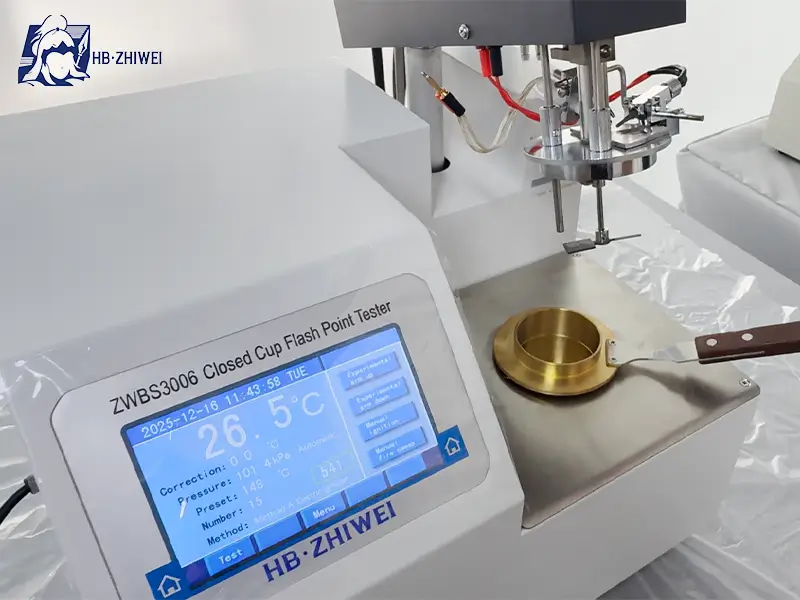
Represented by instruments like the Pensky-Martens Closed Cup (ASTM D93), the core advantage is high sensitivity. It can capture minute traces of flammable vapor, making it the industry standard for most fuels and solvents.
Choose the Closed Cup method if any of the following conditions apply:
Testing Fuel Oils: Essential for determining the lowest temperature threshold where diesel, kerosene, or biodiesel might ignite during storage and transport.
Suspected Contaminant (Fuel Dilution) Detection: When analyzing in-service engine oils, determining if fuel has leaked into the lubricant is crucial. Closed Cup methods capture trace fuel vapors; Open Cup methods allow volatiles to escape, leading to a “false pass” that masks potential hazards.
Adhering to Transport Regulations: Regulations from bodies like the UN, DOT, and IATA require Closed Cup results for flammability classification, as this represents the “harshest operating conditions” during transport.
Testing High-Volatility Samples: Solvents and paints must be tested in a sealed environment to prevent vapor escape that would cause data distortion.
Insulating Oil Detection: Accurately detects dissolved hazardous volatile gases in transformer oils.
Core Applicable Standards: ASTM D93 (Pensky-Martens), ISO 2719, ASTM D56 (Tag), ASTM D1310 (Abel)
Application Scenarios for Open Cup Methods
If the test subject is heavy-duty lubricants, asphalt, or materials for high-temperature conditions, prioritize the Open Cup method.
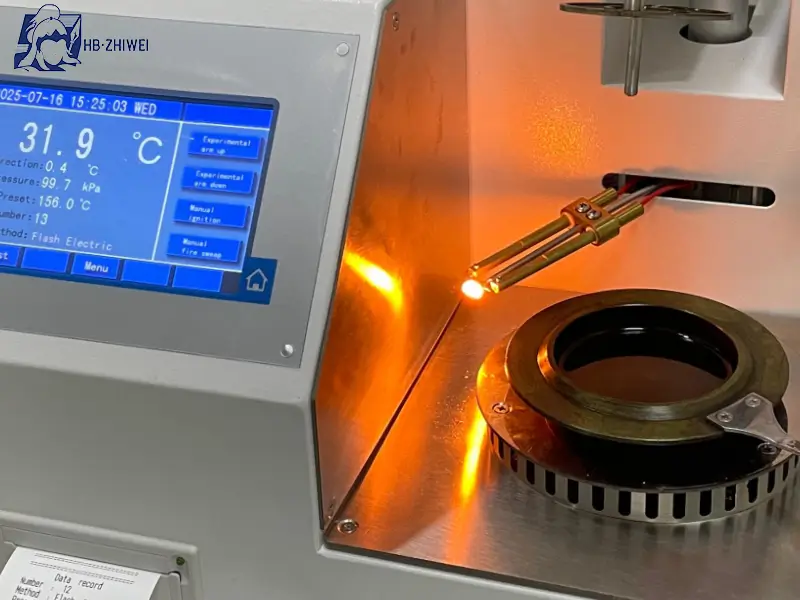
Represented by the Cleveland Open Cup (ASTM D92), the focus here is not on “explosion risk,” but on the stability and sustained burning risk of materials under high-temperature exposure.
Choose the Open Cup method if any of the following conditions apply:
Testing New Lubricating Oils: For fresh engine or gear oils which often operate in open or semi-open high-temperature environments, Open Cup results better align with actual application scenarios.
Preventing Equipment Fire Hazards: The goal is to define the ignition threshold of the bulk oil itself to prevent fires caused by overheating.
Testing Heavy Materials: Asphalt and residues undergo high-temperature open heating during industrial processing. The Open Cup method accurately simulates the risks of these processes.
Determining Fire Point: Only the Open Cup method can measure the Fire Point (the lowest temperature at which a liquid burns continuously for at least 5 seconds). Closed Cup methods restrict oxygen supply, prohibiting sustained combustion.
Core Applicable Standards: ASTM D92 (Cleveland Open Cup), ISO 2592
Analysis of Data Discrepancies (Common Confusions)
A common confusion in the industry is that “the same sample yields different results with the two methods.” This phenomenon is a normal technical difference, not an issue of instrument precision:
Manifestation of Differences
For the same oil sample, the Closed Cup flash point is typically 5°C–20°C lower than the Open Cup flash point. For example: A Closed Cup result might be 150°C, while the Open Cup result for the same sample could reach 160°C or higher.
Crucial Reminder
Never directly compare or mix results from the two methods! For instance: If a client requires “Flash Point > 200°C (ASTM D93)” and you obtain 205°C using ASTM D92 (Open Cup), it is still non-compliant.
If the client hasn’t specified a method, first clarify the sample type: Default to ASTM D92 for lubricants/heavy oils, and ASTM D93 for chemicals/fuels. If doubt remains, prioritize the Closed Cup method to ensure safety compliance with a conservative result.
FAQ of Common Testing Scenarios
Q1: Can I use the Open Cup method to test diesel?
Not recommended. While operationally possible, this violates diesel industry standards (e.g., ASTM D975) and renders the results invalid. Additionally, diesel’s volatility creates a high risk of forming a flammable vapor cloud in the lab, leading to fire accidents.
Q2: I saw a blue halo around the flame source during the test. Does this count as the flash point?
No. This is a common misjudgment. A true flash point requires the flame to spread across the liquid surface (typically covering more than 75%). If only a blue halo (Halo) appears around the ignition source, stopping the test will result in data lower than the true value.
Q3: How do I test a sample with an unknown flash point?
Safety first. Always assume it has a low flash point. Start with a small amount using a Closed Cup method at a low temperature. If you use Open Cup directly on a volatile unknown sample, it might cause a sudden flash fire or hazardous fumes in the lab.
Q4: Can I test samples containing water directly, such as waste oil?
No. Water interferes significantly with flash point testing. It can cause foaming in Open Cup tests or create steam in Closed Cup tests that masks the flammable vapors. You must dewater the sample first (e.g., using calcium chloride or centrifugation) unless the method specifically allows for hydrous samples.
Conclusion
If your focus is safety classification or contamination monitoring, you must choose the Closed Cup method. It provides more conservative data and is the premier choice for transport compliance and detecting fuel dilution.
In contrast, the Open Cup method focuses more on evaluating material thermal stability. It is suitable for new lubricants, asphalt, or heavy oils, mainly serving to judge performance under high-temperature exposed conditions and to determine the Fire Point.
Looking for a Compliant Flash Point Testing Solution?
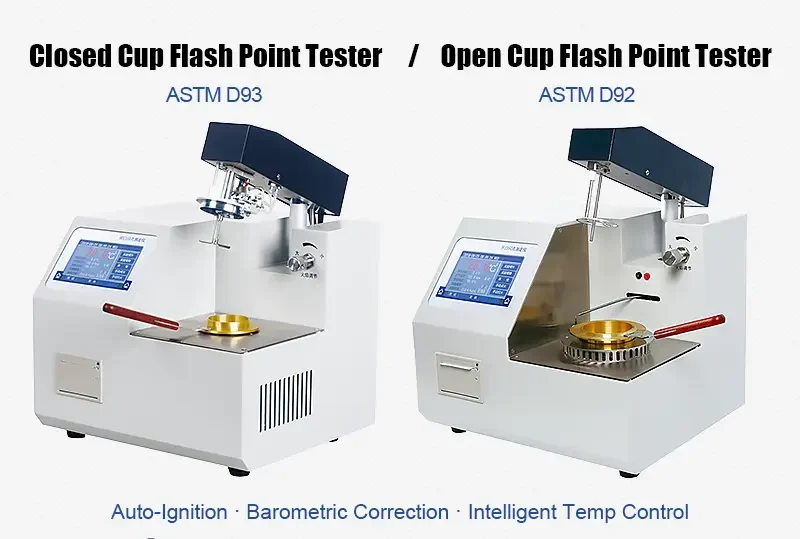
Is your laboratory facing strict ASTM or ISO compliance challenges? Whether it is the highly sensitive Pensky-Martens Closed Cup (ASTM D93) or the highly stable Cleveland Open Cup (ASTM D92), precise data begins with reliable instrumentation.
ZHIWEI provides not only equipment but also comprehensive pre-sales and after-sales technical support. The entire instrument series features automatic ignition systems, real-time barometric pressure correction, and built-in standard method libraries.
They directly match global mainstream standards, ensuring every test result is accurate, compliant, and traceable. Contact us immediately for free method-matching consultation and instrument demonstration services.