
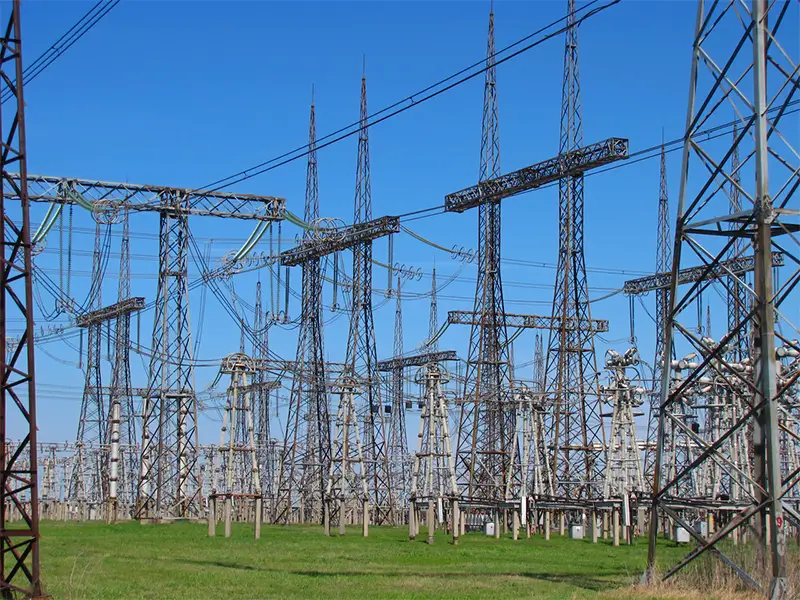
In power systems, transformers are the core equipment for energy transfer and voltage conversion. Their performance directly affects grid safety, economy and stability.
Accurate measurement using a dedicated Transformer Turns Ratio (TTR) Tester is therefore essential throughout manufacturing, installation and maintenance to verify performance, catch defects early and ensure reliable voltage conversion.
Measure the turns ratio to verify device performance
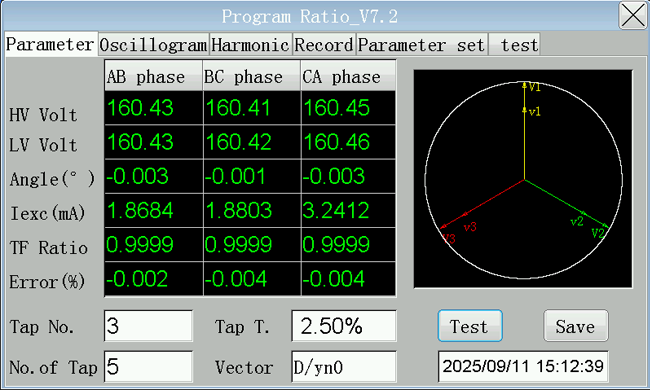
The transformer turns ratio (the turns count ratio between primary and secondary windings) is one of the transformer’s most fundamental technical parameters and directly determines voltage conversion accuracy.
By measuring the turns ratio, you can verify whether the actual ratio matches the design value or the nameplate value, ensuring the equipment meets production standards and engineering requirements.
Before shipping, manufacturers must measure the turns ratio to detect winding count errors, incorrect connections and other issues that may occur during winding.
But a passing factory test doesn’t guarantee the unit is fault-free after transport and storage. On receipt, the construction/installation team should re-measure the ratio to catch hidden problems such as winding displacement or loose connections caused by handling.
A fast, accurate “first inspection” can stop problems before commissioning — lowest cost, lowest risk.
Protect voltage quality and meet load requirements
As the “bridge” for voltage regulation, a transformer’s turns-ratio accuracy directly affects voltage levels across the network.
For example, long-distance transmission uses step-up transformers to raise voltage to high-voltage levels (e.g., 220 kV, 500 kV) to reduce line losses; before power reaches end users, step-down transformers reduce voltage to household (220 V) or industrial (380 V) levels.
If a transformer’s turns ratio deviates, the result can be slight voltage over-voltage or under-voltage at the user end — over-voltage can damage appliances and accelerate aging, while under-voltage can impede motor starting and reduce production efficiency. In severe cases, ratio errors can cause grid voltage fluctuations and affect power supply in neighboring areas.
If the tap position is set correctly and errors are minimized from the start, you reduce repeated complaints and the cost of follow-up inspections for “low/high voltage.”
Regular turns-ratio measurement for fault diagnosis
During long-term service, transformers are affected by temperature, humidity, electromagnetic forces and mechanical vibration, which can lead to inter-turn shorts, inter-phase shorts, tap-changer contact faults, multi-point core grounding, and other issues that cause abnormal turns ratios.
By performing regular turns-ratio measurements and comparing results with historical data and standard values, you can quickly determine whether internal transformer faults exist, identify the fault type and rough location, and provide a basis for maintenance plans.
This helps prevent faults from escalating into transformer burnouts, explosions or grid outages.
Optimize grid operation and improve economic efficiency
Beyond safety, turns-ratio measurements provide data that support grid operation optimization and improve the power system’s economic efficiency.
With precise ratio data, operators can adjust transformer operating conditions to reduce energy losses and improve utilization efficiency.
On one hand, based on measurement results, you can optimize tap-changer positions. For example, during peak demand when customer-side voltage is low, increasing secondary turns (reducing the turns ratio) raises output voltage; during off-peak periods you can adjust the opposite way to avoid excessive voltage and losses.
On the other hand, statistical analysis of ratio data across transformers helps plan grid layout and choose transformer combinations with better ratio matching, reducing circulation losses caused by ratio mismatch and lowering overall operating costs — in short, achieving more efficient energy use.
Why recommend ZWBB201 TTR Tester
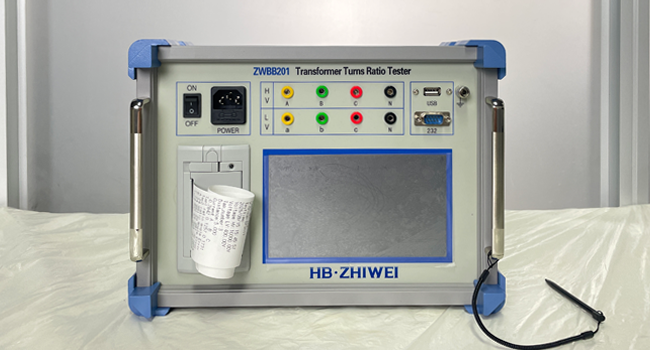
Covers the full chain from verification to diagnosis. HB ZHIWEI ZWBB201 TTR Tester core capabilities:
- Measurement range and accuracy: 0.8-20000;0.1%(0.8-1000)、0.2%(1000-5000)、0.3%(5000-20000)
- Speed and ease of use: no preset parameters required; automatically completes three-phase/single-phase turns-ratio and vector-group determination; results in about 3 seconds.
- Wide compatibility: supports Y/y, Y/d, D/y, D/d, ZN/y, ZN/d and special transformers such as Z-type, rectifier, Scott/inverse-Scott, etc.
- Tap recognition: automatically tracks current tap position; supports complete recording by number of taps and tap step, facilitating comparison with rated tap ratios.
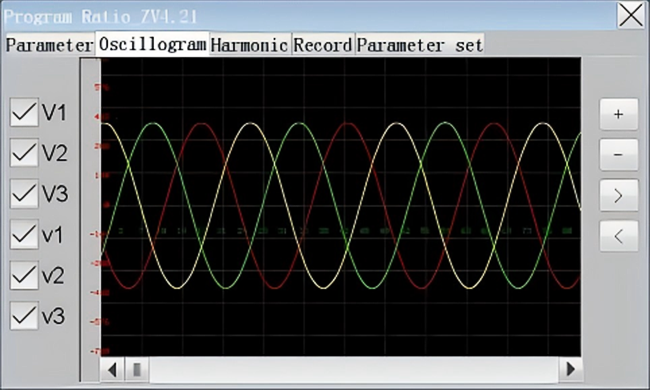
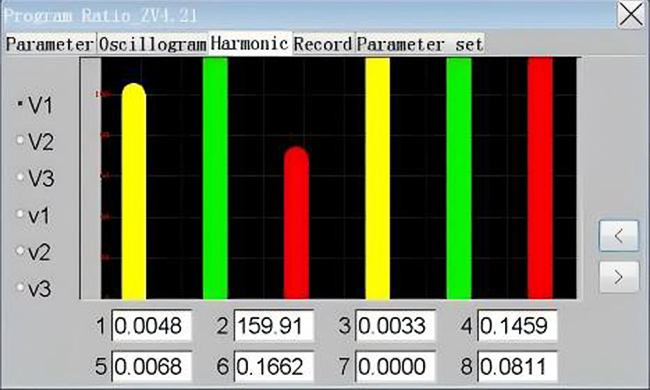
- Fault visualization: primary/secondary vector diagrams, waveform display, phase relationships, excitation current (custom option), harmonic analysis (1st–32nd).
- CT/PT extension: supports CT and PT turns-ratio and polarity testing, improving protection/measurement circuit troubleshooting efficiency.
- Field-friendly: portable size 320 × 230 × 140 mm, approx. 4.5 kg; operating environment -10–50°C, ≤90% RH.
- Protection and self-calibration: automatic abnormal-condition protection; self-calibration distinguishes between cable faults and instrument state.
FAQ of TTR Tester
Q1: Can it measure without entering the rated turns ratio?
Yes. It will provide the measured ratio. To compute the error you must enter the nameplate ratio.
Q2: How should tap step be entered?
Supports entry as either percent or voltage value, e.g., 1.25% per step or 250 V difference between adjacent taps.
Q3: Will unknown vector group affect results?
No. If “unknown” is selected, the instrument automatically recognizes the connection group and polarity.
Q4: Is it normal that the three-phase excitation currents differ?
Yes — this depends on core structure and winding distribution. Phase A/C commonly show higher values and B lower; if deviations are abnormal, further analyze waveforms/harmonics.

Conclusion
Turns-ratio measurement isn’t a one-time “parameter check”; it’s the first line of defense across the transformer’s service life to ensure grid reliability and efficiency.
From factory testing and delivery acceptance to pre-commissioning verification, the ZWBB201 helps turn measurement data into certainty.
Consult Us | Schedule Demo | Get a Quote
Note: Product details described here are based on the ZWBB201 Transformer Turns Ratio Tester specification sheet. For ultra-high-voltage, extra-large capacity or special wiring requirements on site, please consult our technical team for evaluation and trial solutions.