

This comprehensive guide explains how power quality analyzers work, where they should be deployed, and the best practices to help modern enterprises maintain a stable electrical grid, reduce outage risks, and improve overall energy efficiency.
The Importance of a Pure Sine Wave
Power quality refers to the physical characteristics of the electrical energy supplied to a power system. In an ideal scenario, the alternating current (AC) electricity takes the form of a perfectly symmetrical pure sine wave. However, the reality of modern electrical networks is far more complex.
As industrial automation, variable frequency drives (VFDs), and sensitive electronic equipment become ubiquitous in manufacturing, power quality (PQ) has emerged as the critical factor determining production stability, equipment lifespan, and measurement accuracy. Any deviation from the ideal sinusoidal waveform can lead to severe operational issues.
This is where advanced power quality analyzers step in—acting as the diagnostic “doctors” for your electrical grid, capturing anomalies such as voltage sags, swells, harmful harmonics, transients, frequency shifts, and three-phase unbalance.
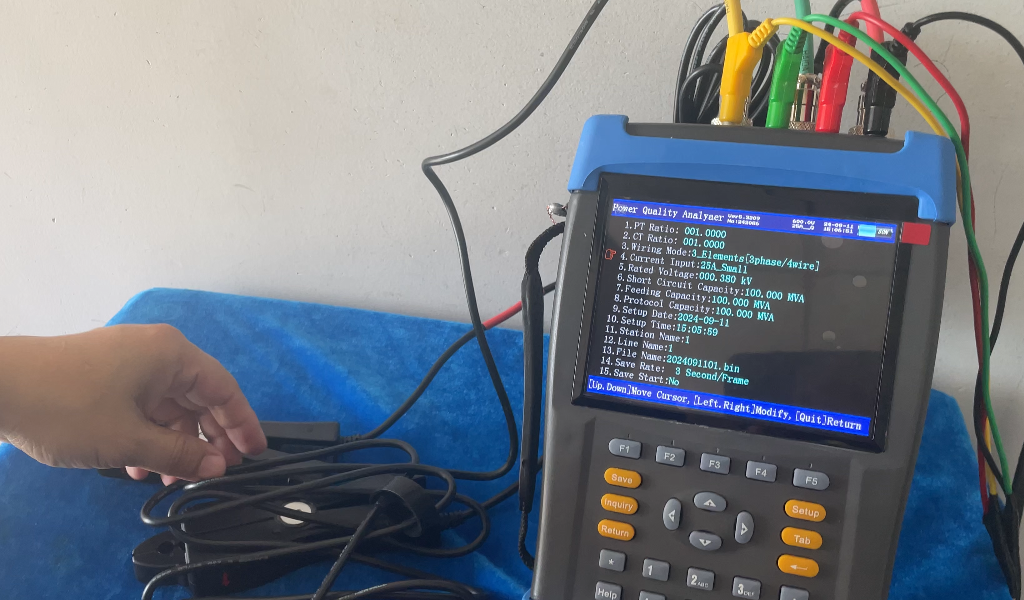
What Is a Power Quality Analyzer and Why It Matters
A power quality analyzer is a highly sophisticated testing instrument designed to continuously measure, log, and analyze electrical parameters, including voltage, current, active power, reactive power, and power factor.
Unlike standard digital multimeters, a professional analyzer complies with stringent international measuring standards (such as IEC 61000-4-30 Class A). It can perform deep-level analysis on Power Quality events:
- Harmonic Analysis: Accurately measuring Total Harmonic Distortion (THD) and individual harmonics (typically up to the 50th or 63rd order).
- Transient Capture: Detecting microsecond-level voltage spikes that can instantly destroy sensitive circuit boards.
- Flicker and Unbalance: Evaluating lighting flicker (Pst and Plt) and checking three-phase voltage and current unbalance to ensure wiring correctness and load distribution.
Its importance is reflected in:
PQ analyzers provide both time- and frequency-domain evidence for incident forensics, making it easier to assign liability and pursue claims, particularly for brief, high-frequency events such as transients and voltage sags/swells.
Support long-term trend analysis to identify progressive issues in advance, such as accumulated harmonics that can lead to capacitor overheating.
It provides quantitative data for energy-efficiency optimization and reactive power compensation, reducing power losses and equipment failure rates—and thus directly impacting maintenance costs and production continuity.
EXPERT GUIDANCE
Need Help Choosing the Right Testing Equipment?
Why Should Your Facility Invest in a PQ Analyzer?
Ignoring power quality issues is a costly mistake. Poor power quality actively degrades your electrical infrastructure. Common symptoms include unexplained motor overheating, the erratic operation of PLCs, inaccurate readings from precision metering instruments, and noticeable lighting flicker.
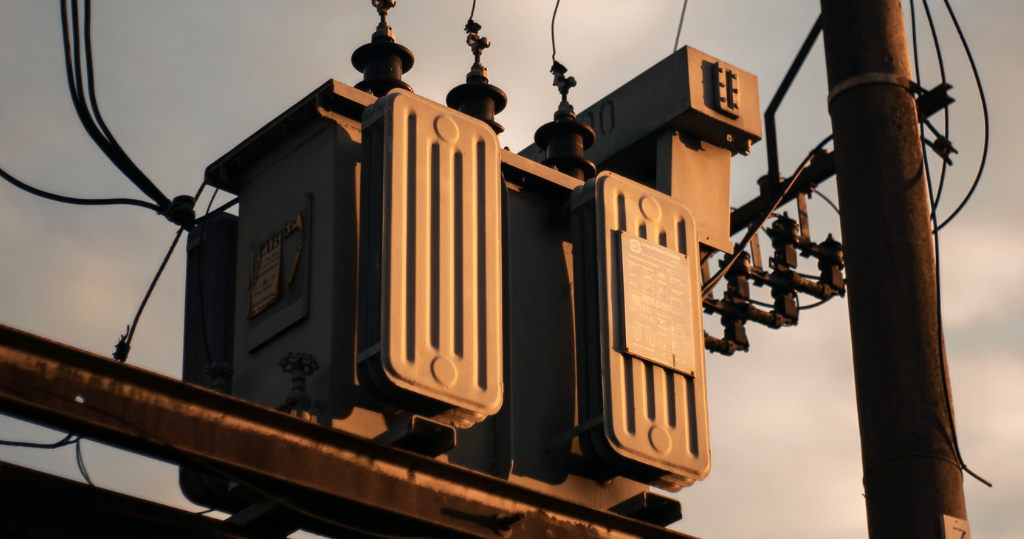
Over time, these unseen electrical disturbances accelerate the degradation of insulation materials within transformers and shorten the lifespan of power factor correction capacitors, exponentially raising the likelihood of catastrophic failures and expensive repair costs.
Moreover, many disturbances that cause hidden production bottlenecks are entirely missed by standard utility billing meters. By utilizing a dedicated power quality analyzer equipped with comprehensive data logging and reporting software, engineers can capture issues the moment they appear, accelerating troubleshooting and significantly reducing the Total Cost of Ownership (TCO).
Essential Application Scenarios for Power Quality Analyzers
Power quality testing is not a one-size-fits-all process. The deployment heavily depends on the industry and the sensitivity of the connected loads.
1. Heavy Manufacturing Workshops
Facilities operating large induction motors, arc furnaces, and welding equipment are notorious for generating severe voltage dips and harmonic pollution. Analyzers here are crucial to ensure these non-linear loads do not destabilize the local microgrid.
2. Data Centers and Server Rooms
Data centers rely on Uninterruptible Power Supplies (UPS) and precision power distribution. Even a millisecond voltage swell can trigger server reboots and massive data loss. Analyzers monitor the transition reliability between mains power and backup generators.
3. Medical Facilities and Hospitals
Hospitals operate highly sensitive, life-saving medical imaging devices (like MRI and CT scanners). Strict adherence to standard EN 50160 for voltage characteristics is monitored using Class A power analyzers to prevent diagnostic errors.
4. Renewable Energy Grid Interconnection Points
With the rise of solar photovoltaic (PV) and wind power, grid tie-in points suffer from harmonic injection from inverters. PQ analyzers provide the necessary compliance reports (such as IEEE 519 harmonic limits) to utility companies before grid integration is permitted.

Portable vs. Fixed Online Monitors
Portable analyzers are the go-to choice for field service engineers conducting temporary troubleshooting, load studies, and transient capturing. Conversely, fixed online PQ monitors are permanently installed at critical switchgear and distribution panels, offering continuous trend analysis, automated alarms, and cloud-based data aggregation for cross-site management.
Power Quality Analyzers Vs. Other Monitoring Tools
Different monitoring tools serve different purposes—here’s a practical comparison:
| Feature dimension | Power Quality Analyzer | Standard Energy Meter | UPS Built-in Monitor | Simple Data Logger |
|---|---|---|---|---|
| Application scenarios | Fault diagnosis, long-term monitoring, energy-efficiency optimization | Energy billing, basic load management | Power protection, battery management | Simple trend logging, long-duration data collection |
| Measurement accuracy | High | Medium | Medium | Medium |
| Transient capture | Strong | None or very weak | Weak | None or very weak |
| Harmonic analysis | Comprehensive (1st–63rd harmonics) | None | Weak | None |
| Waveform viewing | Yes (event waveform plots) | No | No | No |
| Event reporting | Detailed | None | Basic alarms | Simple timestamps |
Power Quality Analyzer Industry Use Cases
To demonstrate the capability of these instruments, let’s review a real-world data analysis from a power quality analyzer installed at a 35 kV monitoring point in an industrial park.
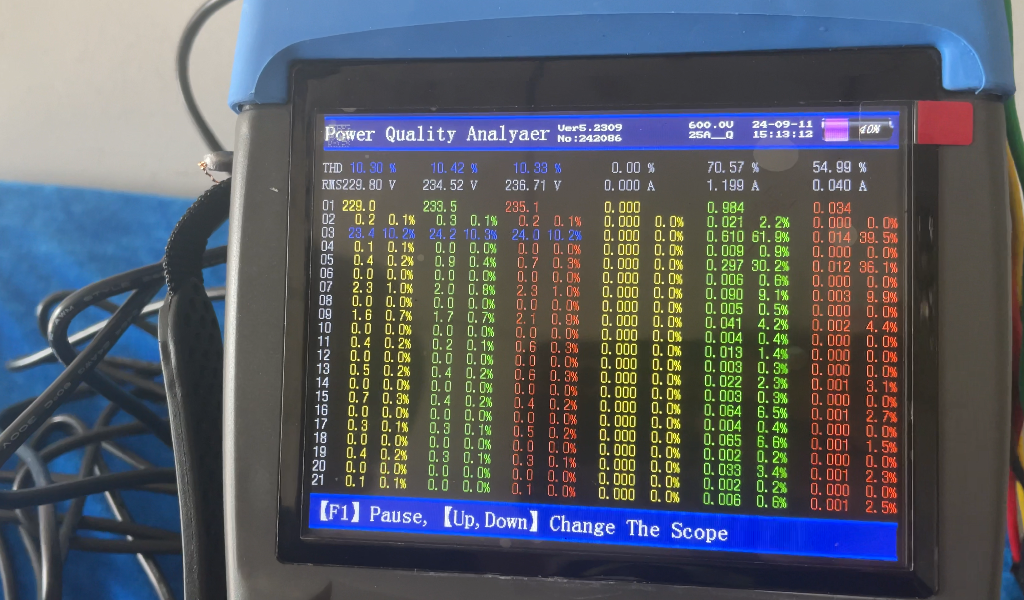
The diagnostic report immediately flagged a critical anomaly: the Total Voltage Harmonic Distortion (THDi and THDv) and the 3rd-harmonic voltage percentage were vastly exceeding acceptable international limits. Simultaneously, 3rd, 5th, and 7th harmonic currents were visibly polluting the line.
Given that the primary load on this feeder line was a fiberglass manufacturing plant, engineers quickly localized the source. The factory operates massive glass melting furnaces—high-energy-consumption smelting devices controlled by large thyristor-based power controllers.
During the melting cycles, the non-linear nature of these controllers caused severe three-phase load unbalance and high-frequency distortion, injecting a massive amount of harmonic current back into the utility grid.
Thanks to the analyzer’s precise waveform capture, the plant was able to design and install specific active harmonic filters (AHF) to clean the sine wave and avoid heavy utility penalties.
FAQ of Power Quality Analyzer
1. Can a PQ analyzer replace a revenue (billing) meter?
A: No. Billing meters are used for legal metering, while PQ analyzers are used for quality monitoring and fault diagnosis.
2. How is data saved and exported?
A: Most devices support local cyclic storage, removable SD cards, or cloud upload. Common export formats include PQDIF and CSV.
3. How to deploy online PQ monitoring?
A: Install fixed monitoring units at critical distribution points. Collect data via Ethernet or wireless links and send it to a local server or cloud platform for remote real-time monitoring and alerts.
4. Should PQ checks be done only after a fault?
A: Do both. Post-fault checks help identify the root cause. Regular inspections (e.g., quarterly or semiannually) reveal slow-developing issues, such as rising harmonic levels — often a precursor to failure.
5. What causes harmonics and which orders are typically monitored?
A: Harmonics are caused by nonlinear loads such as VFDs, rectifiers, welding machines, and LED lighting.
PQ testing typically focuses on orders 2–50; in industry 3rd, 5th, and 7th harmonics are most common (3rd can overload neutrals, 5th can reduce motor torque).
EXPERT GUIDANCE
Need Help Choosing the Right Testing Equipment?
Conclusion
Ensuring good power quality is fundamental to equipment safety, continuous production, and efficient energy use.
We recommend continuous online monitoring, along with periodic diagnostics, to detect and remediate emerging issues early.
Need a reliable solution for power quality monitoring?
We understand your critical requirement for data accuracy and system stability. ZHIWEI offers professional Power Quality Analyzers, specifically designed to precisely pinpoint harmonic interference, voltage sags, and three-phase imbalance.
Whether you need help with equipment selection, operation training, or follow-up advice on power system optimization, our technical team is always on standby.
Speak directly with our experts today to customize the most cost-effective maintenance strategy for your facility.